
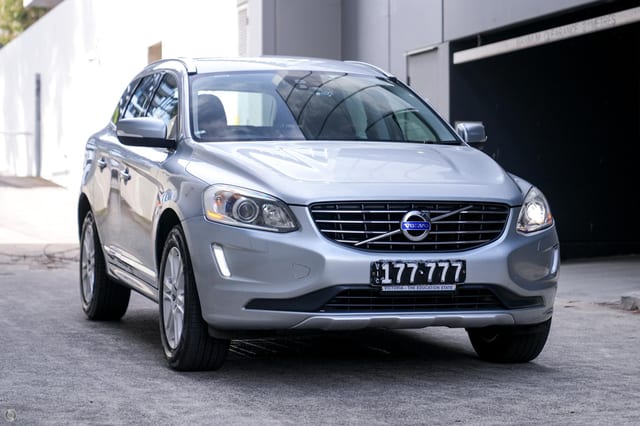
Volvo

Volvo gave away the patent on the three-point seatbelt so any manufacturer could use it, a decision credited with saving countless lives.

2 cars

Filter & Sort

Stock list updated 5 hours ago

Make / Model
Price
–
Year / KMs
–
More Filters

Body

Drive

Fuel

Seats

Cylinders

Paint

Lifestyle

Origin

Discounts

SortJust Arrived (Latest)
Reset all filters

Gothenburg · Torslanda · Clayton · Melbourne

The Volvo story

From a ball-bearing company in Gothenburg to the three-point belt: nearly a hundred years, told in five minutes.

1926 – 1927

A car from a ball-bearing company

Volvo began with two people who had worked for the Swedish ball-bearing maker SKF: sales manager Assar Gabrielsson and engineer Gustaf Larson. They wanted Sweden to build its own cars, and in 1926 SKF's board agreed to back a new company, AB Volvo, with share capital and a loan. SKF also provided the factory premises on Hisingen, in Gothenburg.

The name came from SKF too. Volvo is Latin for “I roll”, and SKF had registered it in 1915 as a name for ball bearings. On 14 April 1927 the first car, the ÖV4, was driven out of the factory gate: an open four-cylinder car whose name is short for Open Car, 4 cylinders, with a two-litre engine making 28 horsepower.

It was not an instant hit. Customers would rather have had six cylinders, and an open car was a hard sell in a Swedish winter, so only 201 sold in the first year. Volvo's own advice was to keep it to 60 kilometres an hour.
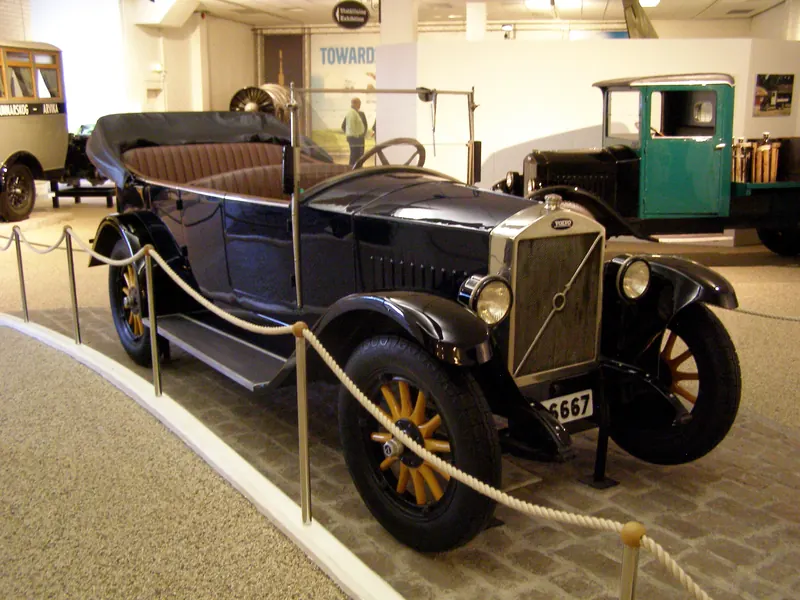
A dark blue open-top 1927 Volvo ÖV4 with yellow wooden-spoke wheels on display at the Volvo Museum
A 1927 Volvo ÖV4 at the Volvo Museum, GothenburgAndrzej Otrębski · CC BY-SA 3.0

1944 – 1958

The Peace Car

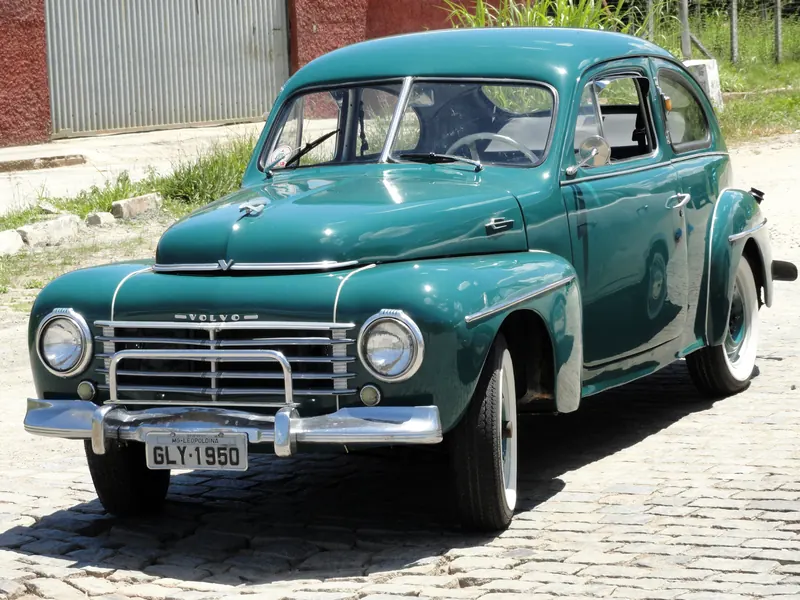
Volvo unveiled the PV444 in Stockholm in September 1944, while the war was still on. Known as the Peace Car, it was a simple, sturdy, affordable car priced at 4,800 kronor, and contracts for 2,300 cars were signed on the spot.

Steel and rubber were short, so the first car was not delivered until 1947, and by then the price had risen to 8,000 kronor. The PV444 also broke with Volvo tradition, using a self-supporting body instead of a body on a separate frame.

In 1949 Volvo built more passenger cars than trucks and buses for the first time, and some 196,000 PV444s were made before the PV544 took over in August 1958. The first Volvos reached the United States in 1955, and North America has been Volvo's main outlet ever since.

A green Volvo PV444 with chrome bumper and grille parked on a cobbled street
A Volvo PV444 from 1950JasonVogel · CC BY-SA 3.0

1956 – 1963

The belt Volvo gave away

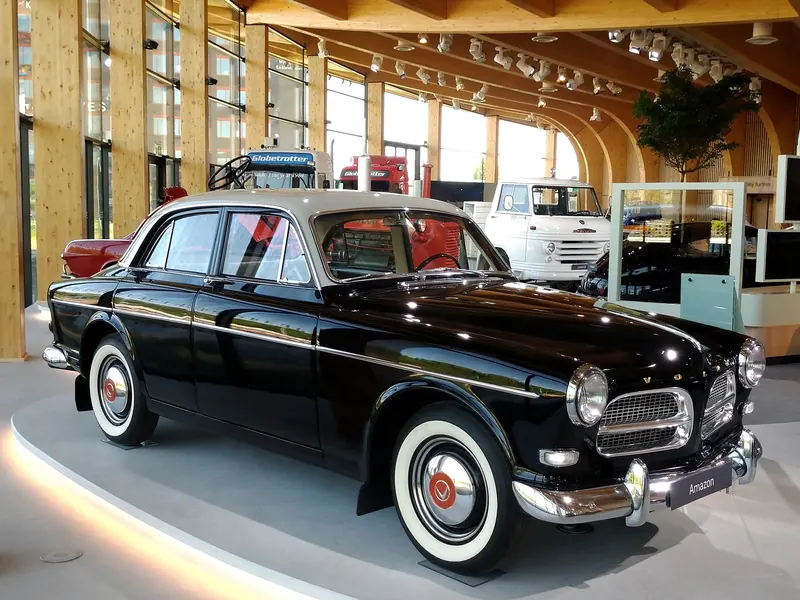
The Amazon arrived in 1956, the first mass-produced car designed by 26-year-old Jan Wilsgaard. It was built for ten years, 667,332 in all, and kept the Amazon name only in the Nordic countries: a German moped maker already owned the name, so elsewhere it was sold as the 121 and 122S.

Meanwhile Volvo had hired a safety engineer. Nils Bohlin, who had worked on ejection seats at Saab, joined in 1958, and Volvo's president, Gunnar Engellau, asked him for a better belt than the two-point ones of the day. Bohlin's answer was a V-shaped three-point belt that could be buckled with one hand.

In 1959 the patented belt became standard on the Amazon and the PV544, which Volvo's museum calls the world's first car models with three-point belts as standard. Volvo says it made Bohlin's patent available to every other carmaker, and by 1963 every Volvo leaving the factory had one in the front seats.

A black Volvo Amazon with whitewall tyres on a display plinth, labelled Amazon
A Volvo Amazon at World of Volvo, GothenburgHerranderssvensson · CC0

1974 – 1993

The brick that went racing

Volvo unveiled the 240 in the autumn of 1974. It was largely based on the 140, with a redesigned front end that took its cues from the 1972 Volvo Experimental Safety Car, and it stayed in production for 19 years.

The 200 Series became the most-produced model in Volvo's history, with 2,685,171 240s and 177,402 260s: 2,862,573 cars in all. The last one left the Torslanda plant on 5 May 1993, ten years longer than planned.

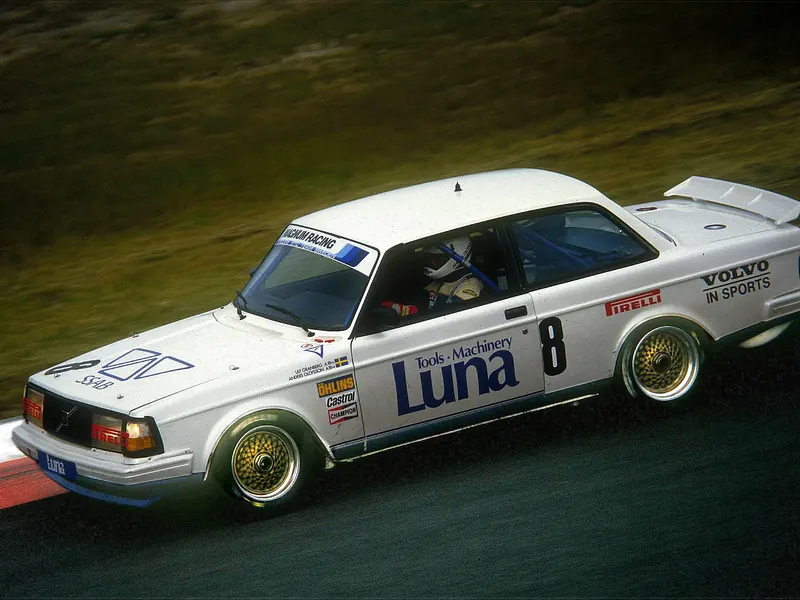
The 240 Turbo suited the new Group A touring car rules so well that Thomas Lindström and Gianfranco Brancatelli won the 1985 European Touring Car Championship in one. The racing version looked nothing like a race car, and was so quick that it earned the nickname the Flying Brick.

A white Volvo 240 Turbo touring car with gold wheels and a rear wing, cornering on a race circuit
Anders Olofsson's Volvo 240 Turbo in practice at the Nürburgring, 1985Lothar Spurzem · CC BY-SA 2.0 de

1926 – today

Who owned Volvo?

A bearing maker's side project, a Swedish company in its own right, then Ford and Geely.

  1. 1926
    SKF

    The ball-bearing maker backs the new AB Volvo with share capital and a loan, and provides the factory premises on Hisingen.

  2. 1927
    Gabrielsson and Larson

    Assar Gabrielsson is managing director and Gustaf Larson technical manager when the first car leaves the factory.

  3. 1935
    AB Volvo

    Introduced on the Stockholm Stock Exchange, after which SKF sells its shares.

  4. 1971
    Pehr G. Gyllenhammar

    Succeeds Gunnar Engellau at the head of Volvo, and over the years tries several times to find a merger partner.

  5. 1993
    Renault talks

    A planned merger with Renault falls through, and Gyllenhammar resigns.

  6. 1999
    Ford

    AB Volvo sells Volvo Cars to Ford to concentrate on commercial vehicles. Two separate companies now share the Volvo name.

  7. 2010
    Geely

    Ford sells Volvo Cars to China's Geely Holding. The deal closes on 2 August 2010.

  8. 2021
    Volvo Car AB

    Volvo Cars lists on the Nasdaq Stockholm stock exchange in October 2021. Geely remains the majority owner.

1994 – 2002

A wagon on the grid

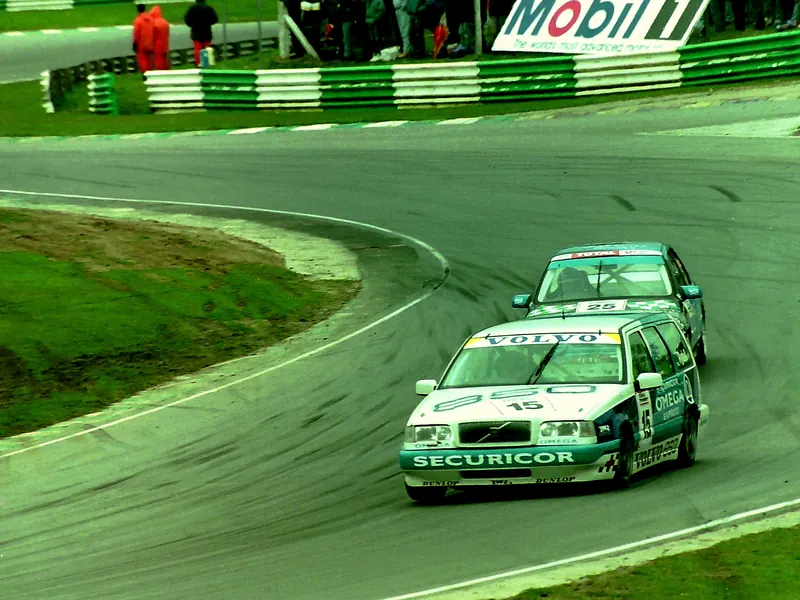
In 1994 Volvo returned to circuit racing after eight years away, and chose an unlikely car: the 850 estate. Built with Tom Walkinshaw Racing, two of them lined up in the British Touring Car Championship, driven by Rickard Rydell and Jan Lammers.

Rivals called them trucks, so Volvo put a stuffed collie in the boot for a parade lap. A rule change ended the estates after one season, but the 850 saloon and the S40 that followed took Rydell to the 1998 championship.

Off the track, Volvo had waited a long time to build an SUV. The seven-seat XC90 premiered in Detroit on 7 January 2002, dealers had 15,000 orders before it launched, and 636,143 were built between 2002 and 2014.

A Volvo 850 estate racing car leading a saloon through a corner at Brands Hatch
Rickard Rydell's Volvo 850 estate at Brands Hatch, 1994Martin Lee from London, UK · CC BY-SA 2.0

1972 – today

Volvo in Australia

Volvos were assembled in Melbourne for sixteen years. In 1972 a deal was signed to build them at the Motor Producers plant in Clayton, and the first Australian-assembled 140 Series cars carried more than 85 per cent local content by value. By the time assembly ended in 1988, about 65,000 Volvos had been built there, from the 140 to the 760.

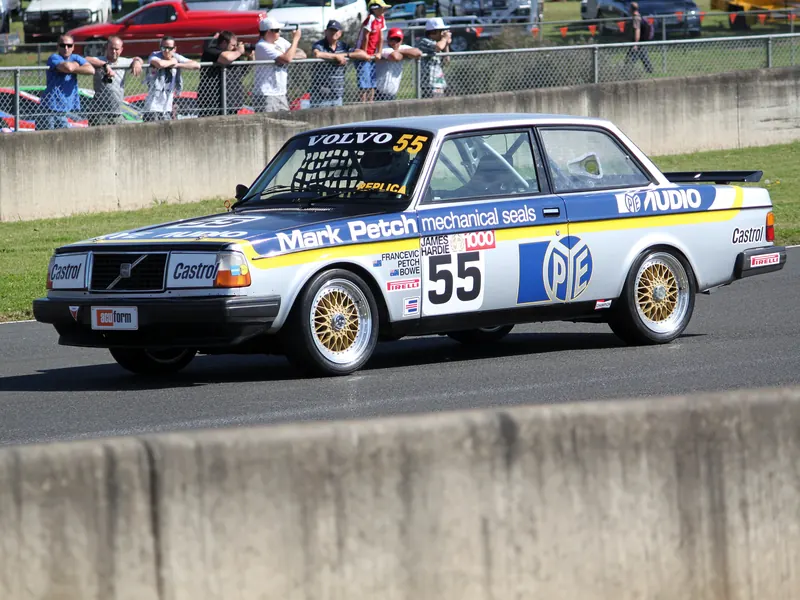
The Flying Brick found its way to Australian race tracks too. In 1986 Robbie Francevic won the Australian Touring Car Championship in a Volvo 240T, the first turbocharged car and the first Swedish car to do it. It began as a private entry from New Zealand's Mark Petch, and Volvo Australia took over the team part-way through the season as the Volvo Dealer Team.

Volvo returned to the grid in 2014, entering two S60s in the V8 Supercars Championship with Garry Rogers Motorsport. They were quick straight away, with ten pole positions and four race wins, and Scott McLaughlin finished fifth in the championship.

A silver, blue and yellow Volvo 240T touring car, number 55, driving on a race circuit
A replica of Robbie Francevic's Volvo 240TJeremy from Sydney, Australia · CC BY 2.0

Myth or fact?

Three things people get wrong

Open a card for the fact.

MythThe first Volvo could only drive backwards.Tap for the fact
Fact

On 14 April 1927 a gear in the rear axle had been fitted wrongly, so the first car had to be backed out of the factory gate. It took ten minutes to fix, and then the car ran as it should. Volvo's museum says the story later took on mythical proportions, which irritated both founders.

MythVolvo invented the seat belt.Tap for the fact
Fact

Seat belts were invented by the English engineer George Cayley for his glider in the mid-19th century, and Nash offered them as a factory option in its 1949 cars. What Volvo's Nils Bohlin developed, and Volvo introduced as standard in 1959, was the modern three-point belt.

MythVolvo cars and Volvo trucks are the same company.Tap for the fact
Fact

They were until 1999. Then AB Volvo sold its car division to Ford, and the Volvo name has been used by two separate companies since. The Volvo Group makes trucks, buses and construction equipment, and Volvo Cars has been owned by Geely Holding since 2010.

By the numbers

Volvo in four figures

1959
the year the three-point belt became standard on the Amazon and PV544
667,332
Amazons built in ten years, 1956 to 1970
2,862,573
200 Series cars built, 240s and 260s together, 1974 to 1993
65,000
Volvos assembled at Clayton, Melbourne, 1972 to 1988 (about)