
BMW

The blue and white roundel takes its colours from the Bavarian flag; the spinning propeller reading came later, from a 1929 company advertisement.

8 cars

Filter & Sort

Stock list updated 5 hours ago

Make / Model
Price
–
Year / KMs
–
More Filters

Body

Drive

Fuel

Seats

Cylinders

Paint

Lifestyle

Origin

Discounts

SortJust Arrived (Latest)
Reset all filters

The BMW story

The BMW story: the one-minute overview, narrated by Michi1:05

1916 – 1922

Aero engines in Munich

BMW began in the air, not on the road. Its origins lie in two aviation companies: the aircraft maker Flugmaschinenfabrik Gustav Otto and the aero engine producer Rapp Motorenwerke. In 1916 Otto's firm was renamed the Bayerische Flugzeugwerke, and in 1917 Rapp Motorenwerke became Bayerische Motorenwerke GmbH: Bavarian Motor Works, or BMW.

The blue-and-white roundel dates from 1917 too, in the colours of Bavaria. On 17 June 1919 a BMW IV engine took pilot Franz Zeno Diemer to 9,760 metres, a height BMW says no aeroplane had reached before. The flight was never officially recognised, because Germany had been excluded from the body that ratified aviation records.

After the First World War aero engines were banned, so BMW made railway brakes and inboard engines for a while. In 1922 its name, assets and engine operations were transferred to BFW, and the company settled at Oberwiesenfeld in Munich, where its main plant and headquarters still stand.
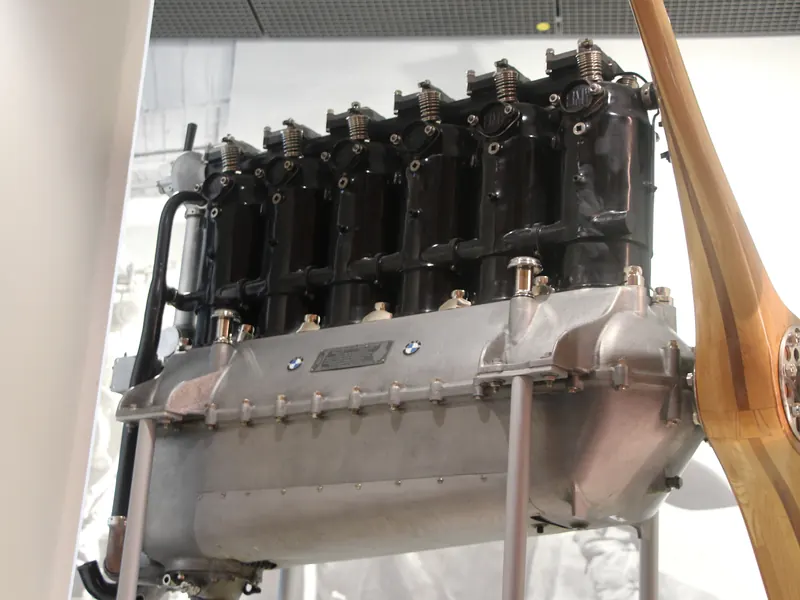
A BMW IIIa aero engine with a wooden propeller blade beside it, on display
A BMW IIIa aero engine in the BMW Museum, MunichWikisympathisant · CC BY-SA 4.0

1923 – 1932

Motorcycles first, then cars

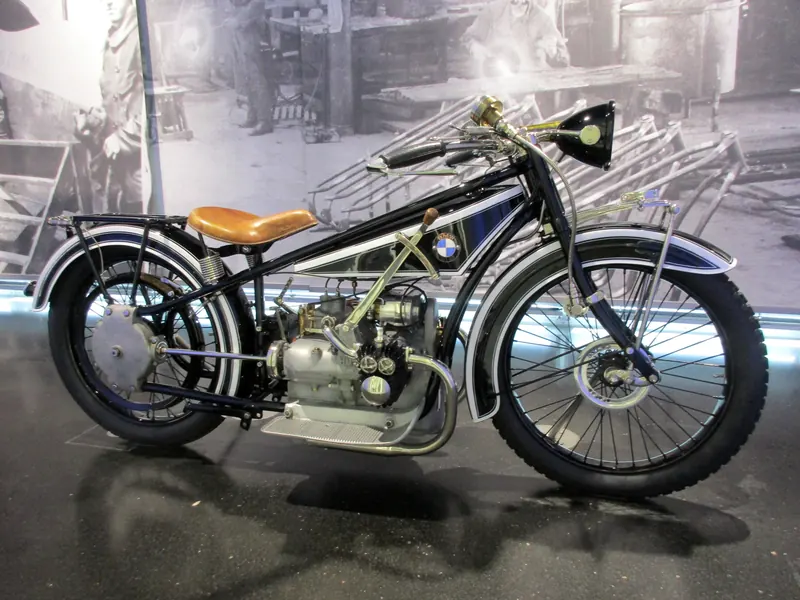
The BMW R 32, shown at the Berlin Motor Show in 1923, was BMW's first motorcycle. Max Friz engineered it around a boxer engine with its cylinders mounted across the frame, and its drive shaft was easier to maintain than a chain or belt. Both are still characteristic features of BMW bikes.

Cars followed in 1928, when BMW took over the vehicle maker Fahrzeugfabrik Eisenach, in Thuringia. From 1929 every BMW car was built at Eisenach until the Second World War, starting with small models made under licence from the Austin Motor Company. BMW's own models arrived in 1932.

That first car was the tiny Dixi, an Austin Seven built under licence, which became the BMW 3/15. Meanwhile the motorcycles were winning: from 1924 to 1929, BMW says, it took every German 500 cc championship.

A 1923 BMW R 32 motorcycle with its boxer engine and wire wheels, in a museum
A 1923 BMW R 32Arnaud 25 · CC BY-SA 4.0

1929 – 1940

Quick on two wheels and four

BMW proved its engineering in record attempts and races. The bars show each machine's recorded speed: two motorcycle world records and one race average.

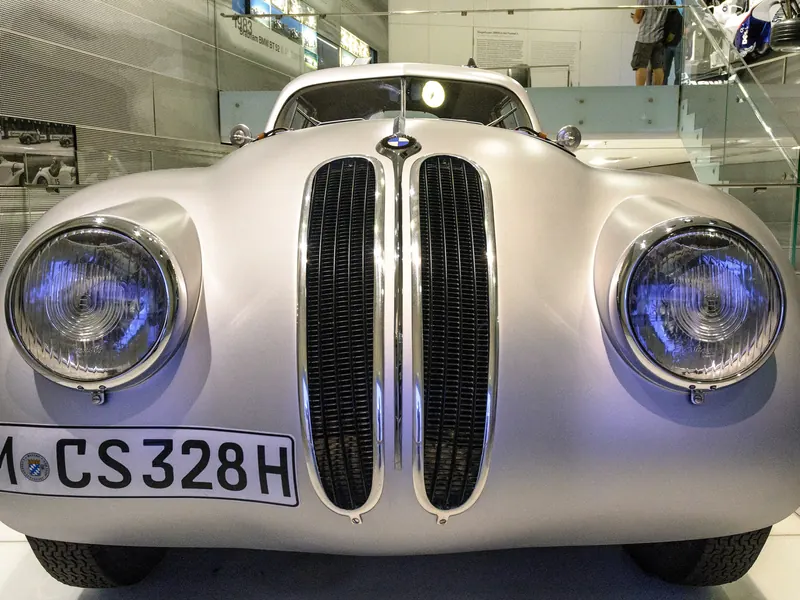
The silver BMW 328 Touring Coupé seen from the front, with twin kidney grilles and round headlamps
The 328 Touring Coupé at the BMW Museum, MunichAnirban Das · CC BY-SA 4.0
  1. Henne's record bike1929 · Supercharged boxer
    216 km/h (134 mph)

    Ernst Henne near Munich on 19 September 1929: 10 km/h above the existing world record.

  2. WR 5001937 · 493 cc, supercharged flat-twin
    280 km/h (174 mph)

    Henne on the Frankfurt-Darmstadt motorway, fully faired: 279.5 km/h, a record that stood until 1951.

  3. 328 Touring Coupé1940 · 2.0 litres, six-cylinder
    167 km/h (104 mph)

    Fritz Huschke von Hanstein and Walter Bäumer won the Mille Miglia outright at an average of 166.7 km/h, 15 minutes clear of an Alfa Romeo.

BMW counts that 1940 win among the most significant in its motor sport history.

1945 – 1960

Dismantled, then nearly sold

Under National Socialist rule BMW became a major armaments maker, and BMW itself says its management showed no ethical restraint in using forced labour, including concentration camp prisoners. After the war allied troops occupied the plants and dismantled machines and tools. In October 1945 the American military government ordered the Munich plant dismantled, and BMW lost control of its assets until 1949.

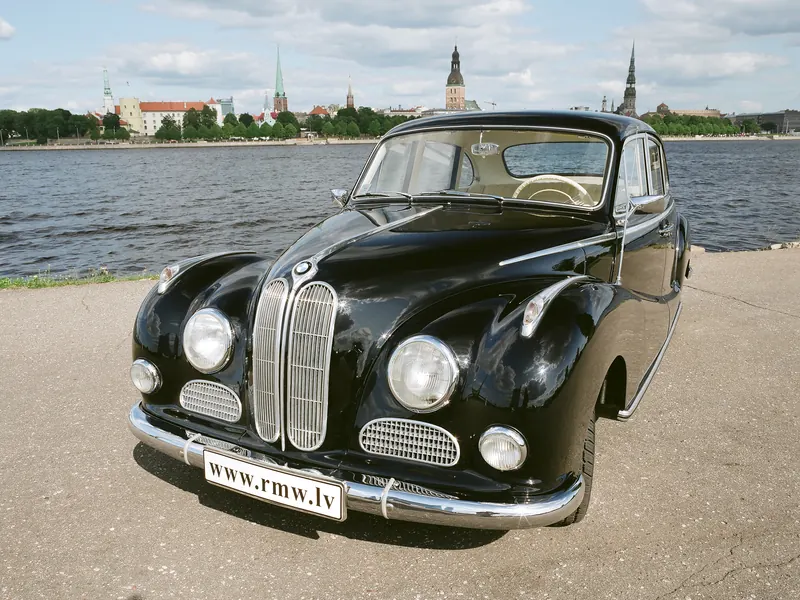
BMW's first product after the war was the R 24 motorcycle, unveiled in March 1948; 9,144 were sold in 1949 alone. The first post-war car was the 501, unveiled in 1951 and built from 1952. It seated up to six and was a luxury car, but enjoyed only limited commercial success.

By the late 1950s BMW's position was precarious. In late 1959 Daimler-Benz made a takeover offer, but at the annual general meeting on 9 December small shareholders and the workforce rejected it. Herbert Quandt then expanded his shareholding and, with temporary government support, turned BMW around the following year.

A black BMW 501 saloon with a chrome kidney grille, parked beside a river
A 1956 BMW 501Laurapulke · CC BY-SA 3.0

1961 – 1973

The Neue Klasse

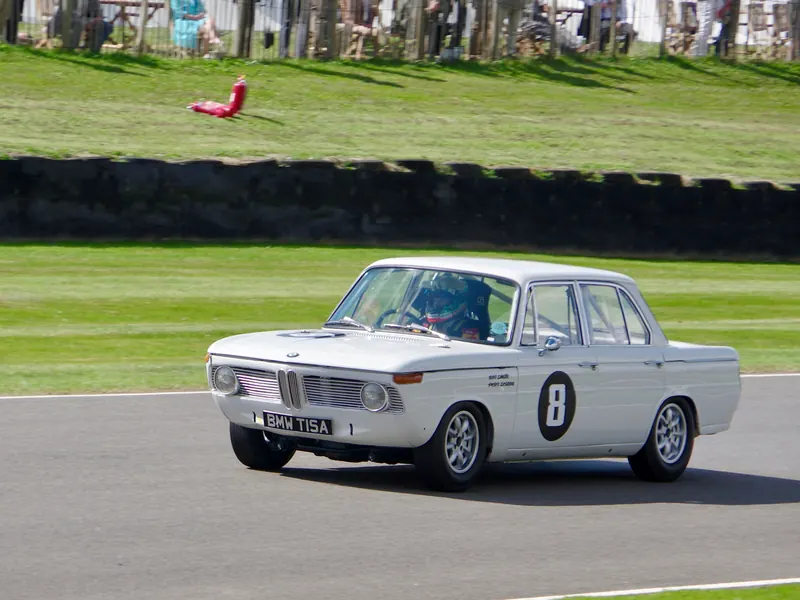
At the 1961 Frankfurt Motor Show BMW unveiled the 1500, a compact, sporty four-door designed to fill a gap in the market. It caused a sensation, and orders far exceeded production capacity. BMW calls it the breakthrough that made it a successful, contemporary carmaker.

The 1500 began the Neue Klasse, or New Class, which grew to include the 1600, 1800 and 2000. The slogan "Sheer driving pleasure" dates from 1964, and in 1972 BMW gathered its racing into BMW Motorsport GmbH, the foundation of what is now BMW M GmbH.

In 1973 BMW opened a new headquarters in Munich. Its distinctive four-cylinder shape soon made it a landmark, and the bowl-shaped BMW Museum stands beside it. The complex was officially opened on 18 May 1973.

A white 1964 BMW 1800 TiSA racing on a circuit
A 1964 BMW 1800 TiSA, a Neue Klasse saloon, at the 2018 Goodwood RevivalDave Hamster · CC BY 2.0

1916 – today

Who owned BMW?

Founders, financiers, a rescuer and a few big purchases, in order.

  1. 1916
    Bayerische Flugzeugwerke

    Gustav Otto's aircraft firm is reorganised and renamed at the government's request. BMW counts its founding date, 7 March 1916, as its own.

  2. 1917
    Rapp Motorenwerke

    Karl Rapp's engine works becomes Bayerische Motorenwerke GmbH, and a year later a public company, BMW AG.

  3. 1922
    Camillo Castiglioni

    The financier, who had bought the BMW name, logo and engine works, folds them into BFW. The company settles in Munich.

  4. 1928
    Fahrzeugfabrik Eisenach

    BMW takes over the vehicle maker in Thuringia and starts building cars.

  5. 1959
    Herbert Quandt

    After shareholders reject a bid from Daimler-Benz, he expands his stockholding and turns BMW around the following year.

  6. 1970
    Eberhard von Kuenheim

    Becomes Chairman of the Board of Management on 1 January 1970, aged 41, and holds the post for 23 years.

  7. 1994
    Rover Group

    BMW buys the home of Land Rover, Rover, MG, Triumph and MINI. It sells Rover in 2000 and keeps MINI.

  8. 1998
    Rolls-Royce

    BMW obtains the brand and naming rights in July. It takes full responsibility for Rolls-Royce Motor Cars at the end of 2002.

  9. Today
    The Quandt family

    Stefan Quandt and Susanne Klatten are the largest shareholders, and the rest is held by the public.

1999 – today

Electric, and a new Neue Klasse

In January 1999 BMW unveiled the X5 at the Detroit Auto Show and, by its own account, established a new market segment: the Sports Activity Vehicle. In 2001 it relaunched MINI, which BMW calls the first premium vehicle in the small-car segment.

The i3, launched in 2013, was the first series-produced fully electric model from the BMW Group. In 2022 the company announced that the Neue Klasse would go into production in 2025.

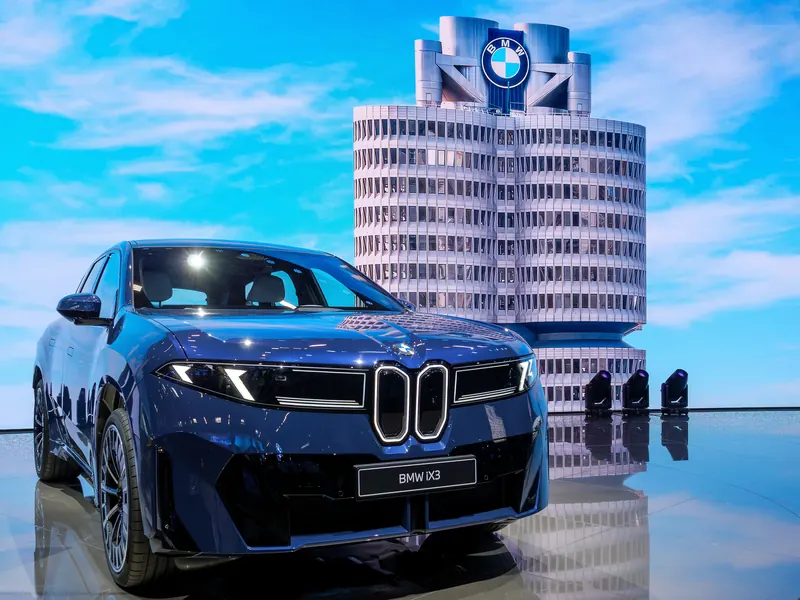
In September 2025 the BMW iX3 made its debut at the IAA Mobility show in Munich as the first production model of the Neue Klasse. It is a return of a name from 1961, when the original Neue Klasse gave BMW its breakthrough.

A blue BMW iX3 at the front of a display, with the BMW four-cylinder tower on the screen behind
The BMW iX3, the first Neue Klasse model, at IAA Summit 2025 in MunichMatti Blume · CC BY-SA 4.0

1966 – today

BMW in Australia

BMW's local arrival is confirmed by a July 1966 issue of Wheels magazine, which ran its first local road test of a BMW, a 2000TI, in September 1967. The first official batch of cars was reportedly just 16.

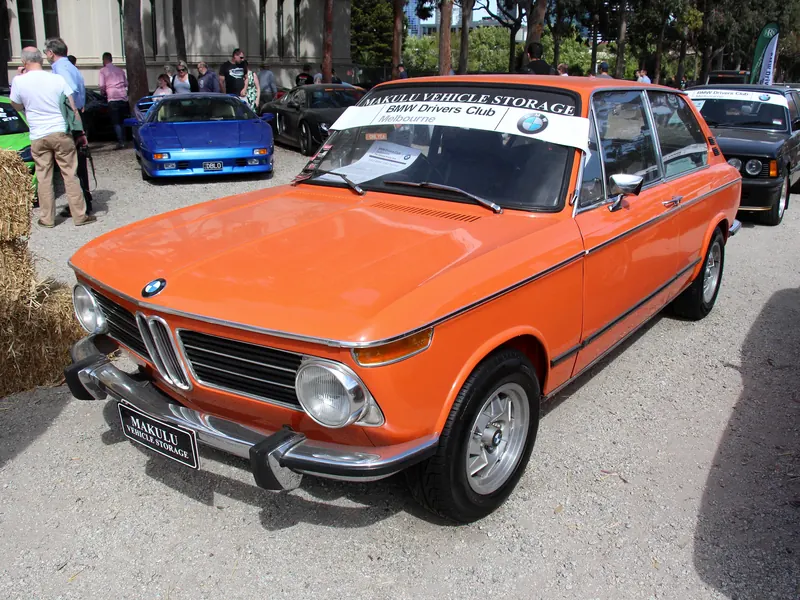
By the mid-1970s Australian franchise dealers were selling and even racing new 2002s. BMW has operated in Australia as a wholly owned subsidiary since 1979, with its national headquarters in Melbourne.

In 1981 a Group C 635 CSi became BMW Australia's factory touring car. In 1985 Jim Richards won the Australian Touring Car Championship in a Group A 635 CSi, BMW's first title and the first for a European-made car since 1963, and he won again in 1987 in an M3.

A 1972 BMW 2002 Touring hatchback, parked on grass
A 1972 BMW 2002 TouringSicnag · CC BY 2.0

Myth or fact?

Three things people get wrong

Open a card for the fact.

MythThe BMW badge is a spinning propeller.Tap for the fact
Fact

The blue and white are the colours of Bavaria, and the logo has been on every BMW since 1917. The propeller reading came later: BMW says the logo was first shown as a stylised rotating propeller in advertising in the late 1920s, and that interpretation has endured.

MythBMW's first car was its own design.Tap for the fact
Fact

BMW's first cars, from 1929, were small models built at Eisenach under licence from the Austin Motor Company. Its own models arrived in 1932.

MythBMW bought Rolls-Royce in 1998.Tap for the fact
Fact

In July 1998 BMW obtained the brand and naming rights for Rolls-Royce motor cars, but Volkswagen held Rolls-Royce until the end of 2002. BMW took on full responsibility for Rolls-Royce Motor Cars then.

By the numbers

BMW in four figures

1916
BMW's official birthday is 7 March, the founding of BFW
9,760 metres
Reached in a BMW IV-powered aircraft on 17 June 1919
167 km/h
Average of the 328 Touring Coupé in the 1940 Mille Miglia
9,144
R 24 motorcycles sold in 1949 alone