
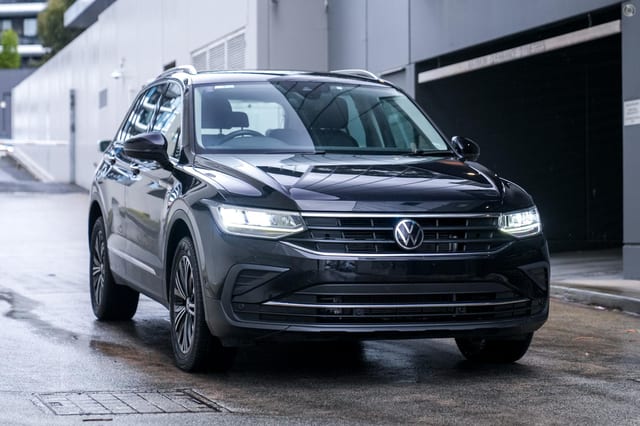
Volkswagen

The Kombi started as a sketch by a Dutch importer who watched a flat parts trolley shuttling around inside the Wolfsburg factory.

4 cars

Filter & Sort

Stock list updated 5 hours ago

Make / Model
Price
–
Year / KMs
–
More Filters

Body

Drive

Fuel

Seats

Cylinders

Paint

Lifestyle

Origin

Discounts

SortJust Arrived (Latest)
Reset all filters

Berlin · Wolfsburg · Zwickau · Clayton

The Volkswagen story

From the people's car to the electric ID.3: almost ninety years, told in five minutes.

1934 – 1945

The people's car, and the regime behind it

Volkswagen is German for people's car, and in the early 1930s several German makers were chasing the idea of an inexpensive one. In January 1934 the engineer Ferdinand Porsche sent the Reich Ministry of Transport a memorandum for his own version. Volkswagen's own history says Adolf Hitler took the idea up, and the German car industry's association commissioned Porsche's office to design the car that June.

The company itself was founded under the Nazi regime. The German Labour Front, a Nazi labour organisation, set it up in Berlin on 28 May 1937, and at the foundation ceremony for the Wolfsburg factory in May 1938 Hitler named the car the KdF-Wagen. Some 336,000 people signed up to a savings scheme to buy one, but not a single car had been produced by the time the war began.

When war came the factory turned to armaments and military vehicles, and from 1940 it used forced labour. Volkswagen's own history estimates 20,000 people, including prisoners of war and concentration camp inmates, and says they made up two thirds of the workforce in 1944. American troops arrived on 11 April 1945 and freed them.
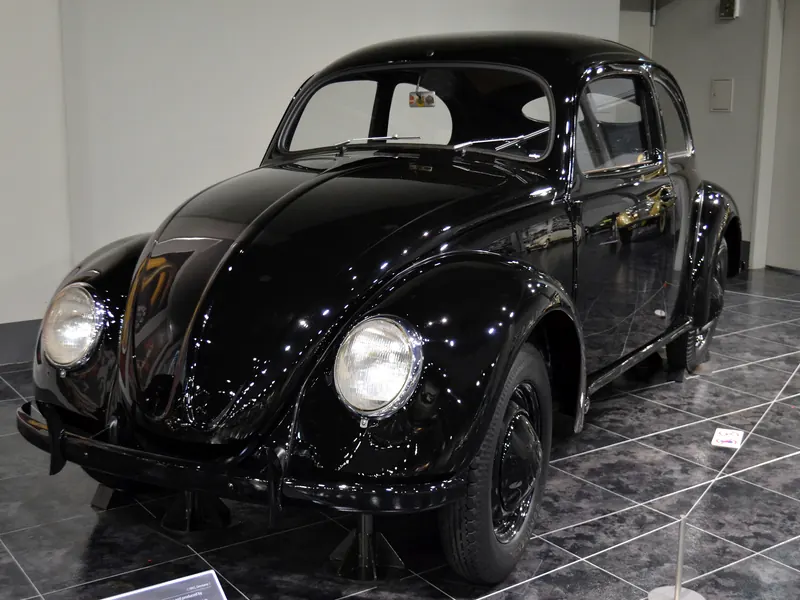
A black KdF-Wagen saloon on display in a museum
A KdF-Wagen saloon built in 1942, at the Toyota Automobile Museum in Japan先従隗始 · CC0

1945 – 1949

Major Hirst restarts the works

In June 1945 the British Military Government took the firm over in trusteeship. Volkswagen's own history says the British chose to restart car production mainly in their own interest, because the occupation forces needed vehicles, and that this saved the plant from threatened dismantling.

Major Ivan Hirst took command as Senior Resident Officer that August. Volkswagen credits his improvisation with solving technical and organisational problems, and says his pressure for better quality became an important factor in its international reputation. Mass production began on 27 December 1945, and 55 vehicles had been built by the end of the year.

The British began exports in 1947, and Heinrich Nordhoff, a former Opel manager, became general director on 1 January 1948. On 8 October 1949 trusteeship passed to the German Federal Government and administration to the State of Lower Saxony, with about 10,000 employees building 4,000 vehicles a month.

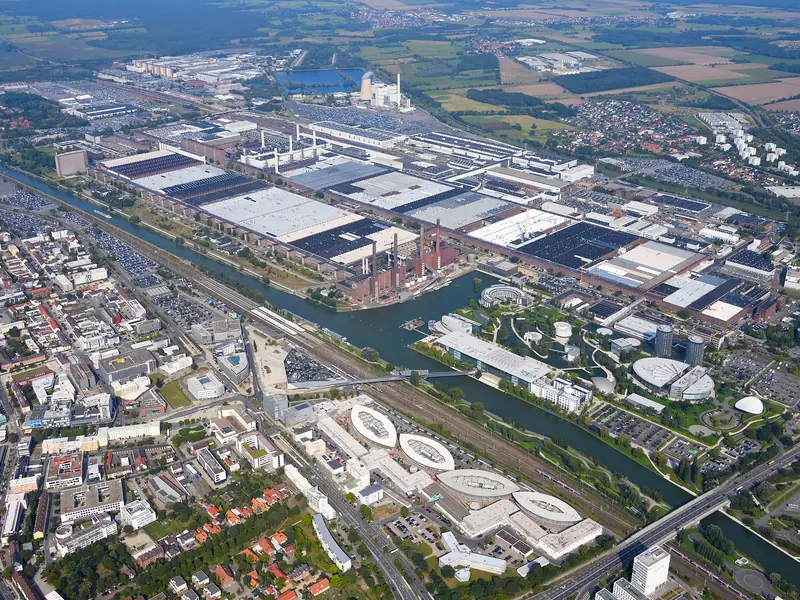
An aerial view of the Volkswagen plant at Wolfsburg beside the Mittelland Canal
The Wolfsburg plant beside the Mittelland Canal, from the airCarsten Steger · CC BY-SA 4.0

1950 – 2003

The Beetle goes round the world

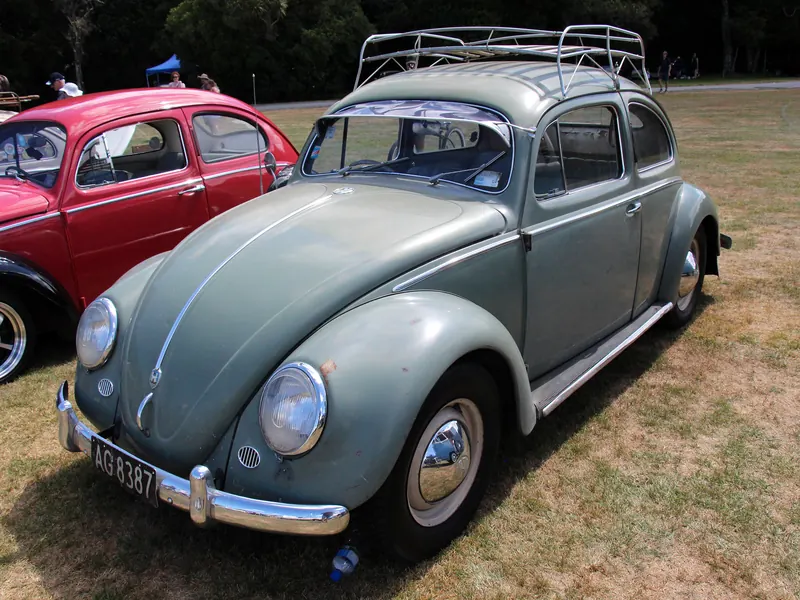
In West Germany in the 1950s, Volkswagen's own history says, the Beetle was the best-selling car of the decade, with a market share of around 40 per cent. The Transporter van, built from 1950, was no less successful.

The one millionth Volkswagen was built at Wolfsburg on 5 August 1955. Exports reached Europe, the Americas and Africa, with production sites set up in Brazil, South Africa and Australia, and in the United States the agency Doyle Dane Bernbach created advertising classics such as "Think small" and "Lemon".

On 17 February 1972 the Beetle passed the Ford Model T's record, with 15,007,034 built. The last saloon Beetle built in Germany left the Emden line in January 1978, but production went on in Mexico, where the final one was built on 30 July 2003. In all, 21,529,464 Beetles were made.

A pale green 1957 Volkswagen Beetle with a roof rack, parked on grass
A 1957 Volkswagen BeetleSicnag · CC BY 2.0

1974 – 2002

The Golf takes over

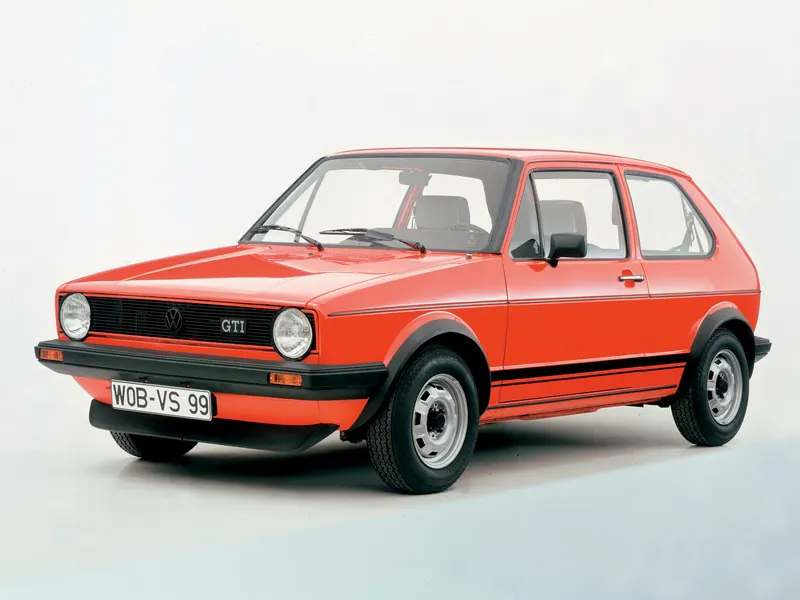
By the early 1970s the air-cooled Beetle was losing ground to a new generation of small cars with water-cooled engines, front-wheel drive and plenty of space inside, Volkswagen's own history says. Its answer was the Golf, designed by the Italian Giugiaro, which went into production in Wolfsburg on 29 March 1974.

The Golf was named after the Gulf Stream as well as the game of golf. In 1976 it was joined by the sporty GTI, with 110 horsepower, and by a diesel, and the one millionth Golf was built on 27 October 1976.

Volkswagen says the new generation, the Golf and the Passat among them, arrived at the right time to help it through the oil crisis of 1974 and 1975. In June 2002 it counted the Golf as the most-built Volkswagen ever, ahead of the Beetle.

A red first-generation Volkswagen Golf GTI against a plain white studio backdrop
A first-generation Golf GTIVolkswagen AG · CC BY 3.0

1937 – today

Who owns Volkswagen?

From the German Labour Front to a military trustee, a state, public shareholders and two families, with a crowd of brands collected along the way.

  1. 1937
    German Labour Front

    A labour organisation of Nazi Germany sets the company up in Berlin on 28 May. Ferdinand Porsche is one of its three directors.

  2. 1945
    British Military Government

    Takes the firm over in trusteeship in June, and Major Ivan Hirst takes command at the works in August.

  3. 1948
    Heinrich Nordhoff

    A former Opel manager becomes general director on 1 January, and leads the company for twenty years.

  4. 1949
    Federal Government and Lower Saxony

    On 8 October the British hand trusteeship to the German Federal Government and administration to the State of Lower Saxony.

  5. 1960
    A public company

    A law passed on 21 July provides for 60 per cent of the shares to be sold to the public. The rest is split between the Federal Government and Lower Saxony.

  6. 1965
    Auto Union

    Volkswagen buys 75.3 per cent of Daimler-Benz's Auto Union on 1 January. Audi carries on as an independent brand within the group.

  7. 1986
    SEAT

    Volkswagen buys 51 per cent of the Spanish carmaker on 18 June.

  8. 1991
    Škoda

    The Czech carmaker joins the group on 16 April as its fourth independent brand.

  9. 1998
    Bentley, Lamborghini and Bugatti

    Volkswagen brings three luxury brands into the group.

  10. 2012
    Porsche

    On 1 August Volkswagen takes 100 per cent of Porsche AG, which it runs as an independent group brand.

  11. 2025
    Porsche SE and Lower Saxony

    At the end of 2025 Porsche SE holds 53.3 per cent of the voting rights, Lower Saxony 20.0 per cent and Qatar Holding 17.0 per cent. Porsche SE's voting shares are held by the Porsche and Piëch families.

2014 – today

Plugging in

In September 2015 US authorities published documents about the manipulation of diesel engines, and Martin Winterkorn resigned as chairman of the management board. Volkswagen's own history calls the diesel issue the biggest crisis in its history, and also a turning point that re-aligned the business towards electric and digital mobility.

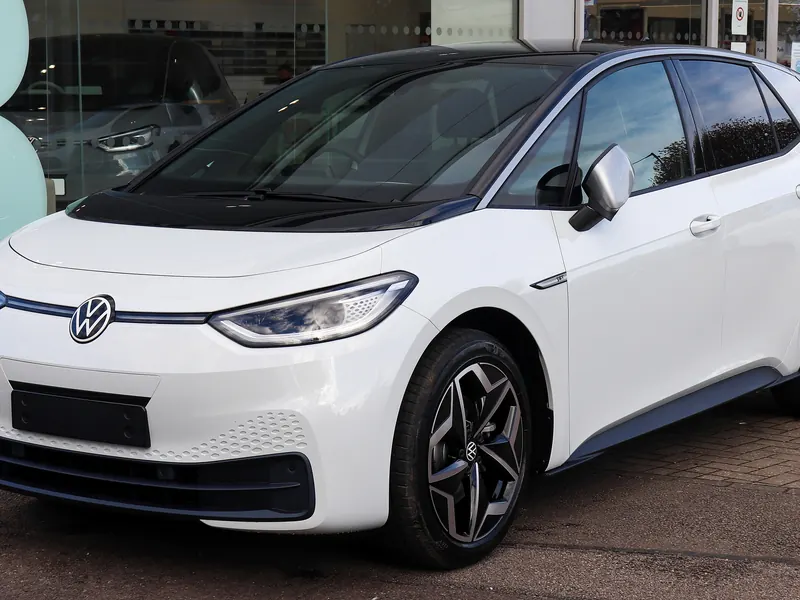
Production of the e-Golf started in Wolfsburg in March 2014. On 4 November 2019 Volkswagen began building the ID.3 at Zwickau, a plant it had completely converted to make electric cars. The ID.3 is based on Volkswagen's modular electric drive matrix, known as MEB, which the company says allows ranges of up to 500 kilometres.

A white Volkswagen ID.3 parked outside a showroom
A Volkswagen ID.3Vauxford · CC BY-SA 4.0

1954 – 1976

Made at Clayton, Victoria

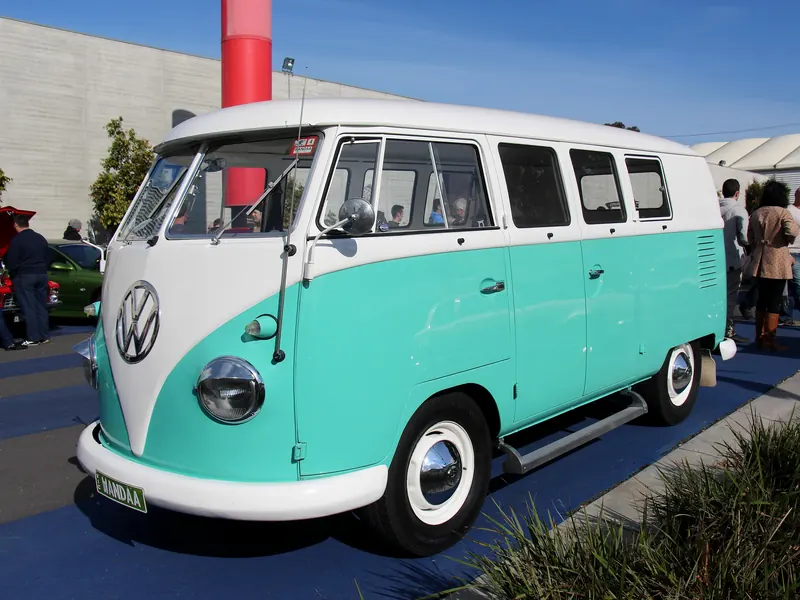
Volkswagens went on sale in Australia in 1954, and that June Martin and King, a railway carriage builder at Clayton in Melbourne's south-east, started assembling them from kits. A Volkswagen club history says its builders found the German kits the most precise fit they had ever seen. In 1955 Volkswagens were declared first and second in the Redex Trial, a reliability trial of more than 15,000 kilometres over some of Australia's roughest rural roads, after three months of protests.

In December 1957 Volkswagen set up its own company in Melbourne, and in 1962 it moved from assembling kits to making cars. Australia became the first country outside Germany to press Volkswagen body panels, and by 1962 the Beetle was almost all Australian content. In 1967 Volkswagen Australia developed a model of its own, the Country Buggy, using Beetle and Kombi parts.

From 1968 the plant went back to assembling imported kits, and in 1976 Nissan took it over. The 260,055th and last Australian-made Beetle left the Clayton line on 15 July 1976, though Nissan carried on assembling the Golf there alongside the Transporter.

A turquoise and white 1956 Volkswagen Transporter at a car show
A 1956 Volkswagen Transporter, known in Australia as the KombiSicnag · CC BY 2.0

Myth or fact?

Three things people get wrong

Open a card for the fact.

MythPeople who saved for a KdF-Wagen before the war got their car.Tap for the fact
Fact

Some 336,000 people signed up to the savings scheme, but Volkswagen's own history says not a single car had been produced by the time the war began. In 1961, after 12 years, former savers who had gone to court settled for a discount of up to DM 600 on a Volkswagen, or up to DM 100 in cash.

MythThe last Beetle was built in Germany.Tap for the fact
Fact

The last saloon Beetle built in Germany came off the Emden line in January 1978. The very last Beetle of all, number 21,529,464, was built at Puebla in Mexico on 30 July 2003.

MythThe Golf is named only after the sport.Tap for the fact
Fact

Volkswagen's own history says it was named after the Gulf Stream as well as the game of golf.

By the numbers

Volkswagen in four figures

55
vehicles built by the end of 1945, under British administration
21,529,464
Beetles built, the last in Mexico in 2003
1,000,000
Golfs built by 27 October 1976
260,055
Beetles made at Clayton, Victoria, the last in 1976