

Toyota

The founding family is named Toyoda, but the brand became Toyota because the katakana spelling takes eight strokes, an auspicious number in Japan.

5 cars

Filter & Sort

Stock list updated 5 hours ago

Make / Model
Price
–
Year / KMs
–
More Filters

Body

Drive

Fuel

Seats

Cylinders

Paint

Lifestyle

Origin

Discounts

SortJust Arrived (Latest)
Reset all filters

The Toyota story

The Toyota story: the one-minute overview, narrated by Michi1:03

1891 – 1929

Looms before cars

Toyota's story starts with a loom, not a car. Sakichi Toyoda, born in 1867 in what is now Kosai, Shizuoka Prefecture, was awarded a patent for an improved wooden hand loom in 1891. Toyota's own history says he focused on making things easier for his mother, who worked late into the night operating a manual loom.

His later looms stopped themselves when a thread broke, the seed of what Toyota still calls jidoka, or "automation with a human touch". The first Type G automatic loom came off the production line in November 1925, and Toyoda Automatic Loom Works was established in Kariya on 18 November 1926.

In December 1929 Sakichi's son Kiichiro signed a patent deal with the British loom maker Platt in England, which called for 100,000 pounds in total. Toyota's history says that on the journey he was preoccupied with observing Ford's car plants and researching machine tools.
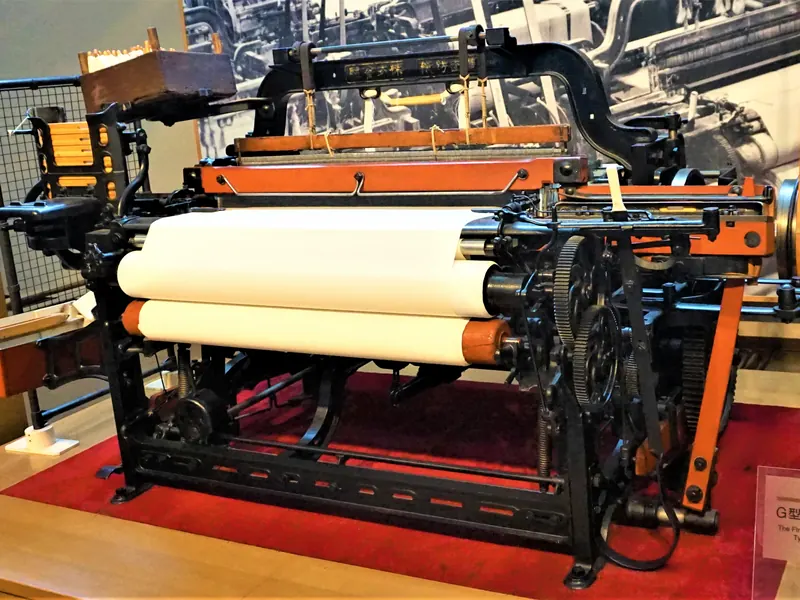
A black and orange Type G automatic loom with rolls of white cloth, on a red cloth in a museum
A Type G automatic loom, Toyota Commemorative Museum of Industry and TechnologyJoyofmuseums · CC BY-SA 4.0

1933 – 1937

A car, and a new spelling

On 1 September 1933 Kiichiro set up an Automotive Production Division at the loom works, not yet an official part of the company, and that October he took apart a 1933 Chevrolet and sketched its parts. He chose a design that shared parts with the Fords and Chevrolets already on Japanese roads, so owners could use familiar service parts.

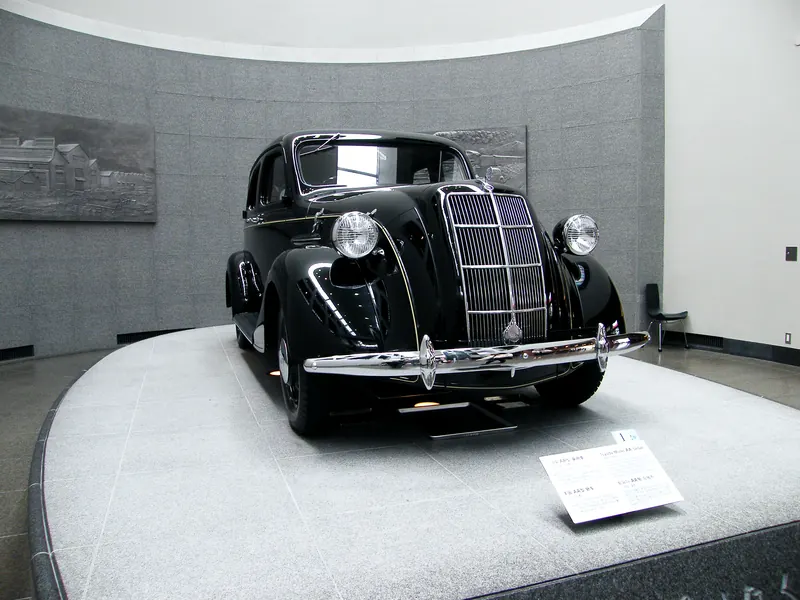
The Model A1 prototype was finished in May 1935, in under two years, and it still used many genuine Chevrolet parts. The improved Model AA followed in 1936.

In October 1936 the company switched from Toyoda to Toyota, with a new logo chosen in a public competition. The new spelling looked cleaner, sounded sharper, moved away from a personal name, and takes eight strokes to write, which is thought to be auspicious. Toyota Motor Co., Ltd. was registered on 28 August 1937.

A black Toyoda Model AA sedan on a round stone platform in a museum
A Toyoda Model AA at the Toyota Automobile MuseumEmran Kassim · CC BY 2.0

1938 – 1954

Just in time

When the Koromo Plant opened in 1938, Kiichiro proposed Just-in-Time production: make only what is needed, when it is needed, and in the amount needed. Toyota records his conviction like this: "A complete car cannot be built if even one part is missing."

Wartime rationing of production materials in 1939 made the idea impossible to run, and it was suspended. It was not fully realised until 1954, when a "supermarket method" was proposed, in which each process takes what it needs from the one before, with the kanban as the tool.

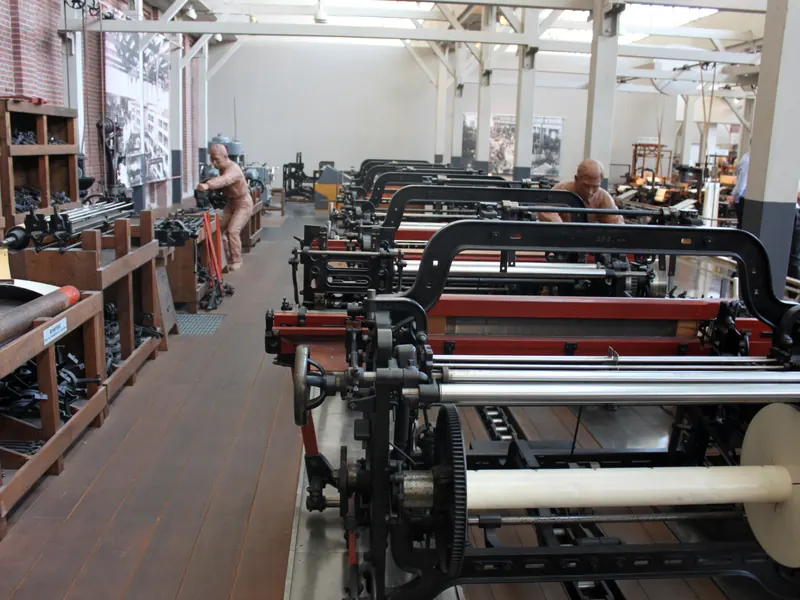
Together with jidoka, Just-in-Time became one of the two pillars of the Toyota Production System. Toyota says the system has roots tracing back to the automatic loom Sakichi invented.

A long hall of Toyoda automatic looms in rows, with figures of weavers at work, in a museum
Toyoda automatic looms in a museum display of mass productionBsBsBs · CC BY-SA 3.0

1955 – 2021

From Crown to Corolla

The Toyopet Crown, Toyota's first full-scale passenger car, went into production on 1 January 1955. Work on it began in 1952, and Toyota had declared its ambition to build on purely home-grown technology.

It was also the first Japanese car exported to and sold in the mainland United States. The first two docked in California on 25 August 1957, and Toyota Motor Sales was set up in Hollywood that October.

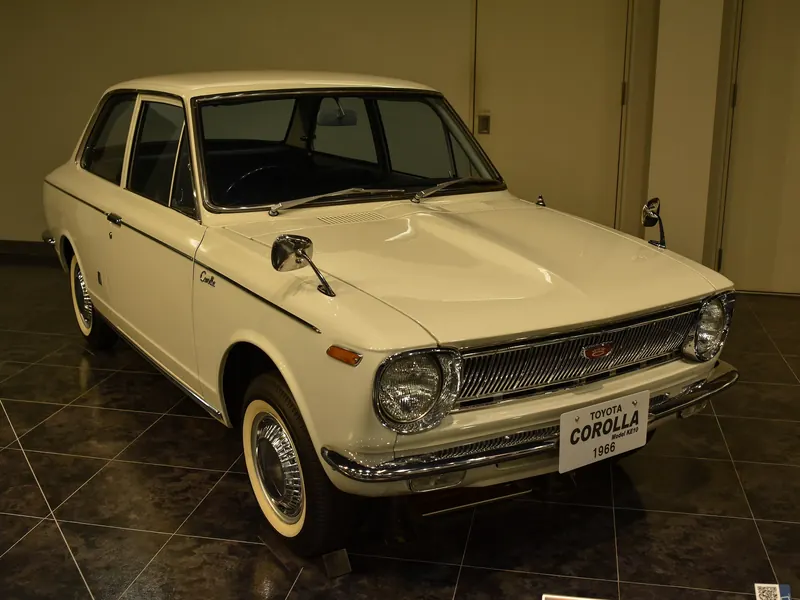
The Corolla was introduced in Japan in 1966. Exports to North America began in 1968 and sales reached a million by 1970. In 2021 Toyota reported that more than 50 million had been sold since the first one rolled off the line in 1966.

A cream 1966 Toyota Corolla two-door sedan with whitewall tyres in a museum
A 1966 Toyota Corolla (KE10) at the Toyota Automobile MuseumCoolalabright · CC BY 4.0

1907 – today

Who has run Toyota?

From a loom works to a car company, a sales company and, since 1982, one corporation: how Toyota's shape, and the people at the top, have changed.

  1. 1907
    Toyoda Loom Works

    Sakichi Toyoda's business becomes a company in Nagoya, with Sakichi as managing director and chief engineer.

  2. 1926
    Toyoda Automatic Loom Works

    Founded in Kariya on 18 November to build the Type G loom. Risaburo Toyoda is president and Kiichiro Toyoda managing director.

  3. 1937
    Toyota Motor Co., Ltd.

    The car business is spun off and registered on 28 August. Risaburo Toyoda is president and Kiichiro Toyoda executive vice president.

  4. 1950
    Two companies

    Toyota Motor Sales is set up on 3 April. On 5 June Kiichiro resigns over a labour dispute, and Taizo Ishida is to succeed him.

  5. 1982
    Toyota Motor Corporation

    On 1 July the two companies merge, making Toyota one company again for the first time in 32 years. Eiji Toyoda becomes chairman and Shoichiro Toyoda president.

  6. 2009
    Akio Toyoda

    Kiichiro's grandson is appointed president after the 23 June shareholders meeting, and Katsuaki Watanabe becomes vice chairman.

  7. 2023
    Koji Sato

    Sato, who oversaw Lexus and Gazoo Racing, is promoted to president from 1 April, and Akio Toyoda becomes chairman.

  8. 2026
    Kenta Kon

    Chief financial officer Kenta Kon takes over as president and CEO from 1 April, and Koji Sato becomes vice chairman and chief industry officer.

1997 – 2000

The Prius

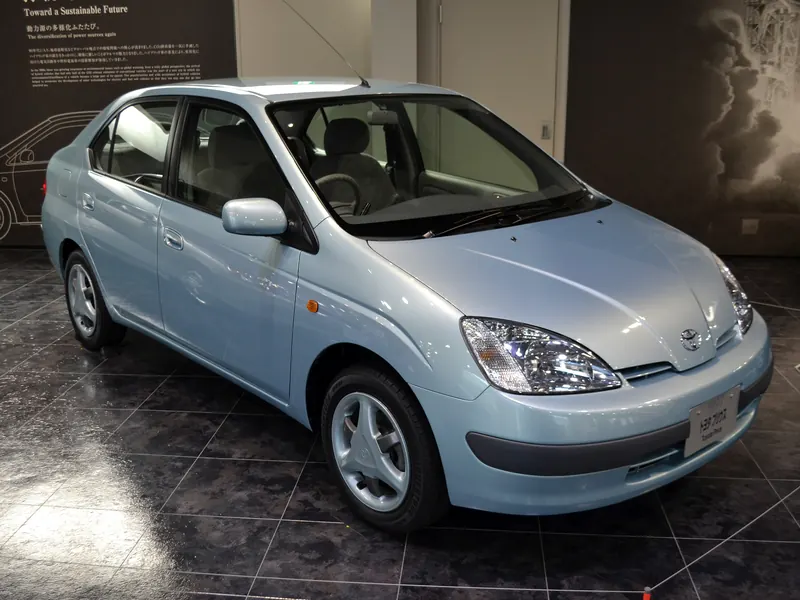
Toyota launched the Prius in Japan in late 1997, the culmination of a five-year effort to bring a practical, low-emission family vehicle to market. Toyota calls it the world's first mass-produced petrol-electric hybrid vehicle. It used both an internal combustion engine and two electric motors.

The name is Latin for "to go before". Sales in Japan were extremely strong from the outset, helped by the Prius winning Japan's Car of the Year award for 1998, and by May 2000 more than 40,000 had been sold.

Toyota says the principles and basic architecture of that first Prius have been applied across every Toyota hybrid since. It was also the first appearance of a new platform that went on to underpin models such as the Corolla, Celica and RAV4.

A pale blue first-generation Toyota Prius sedan on a museum floor
A first-generation Toyota Prius, made in 1997, at the Toyota Automobile Museum先従隗始 · CC0

1958 – 2017

Toyota in Australia

Toyota's story here began in 1958, when contractor Thiess won work on the Snowy Mountains Hydro-Electric Scheme and privately imported about a dozen LandCruisers. Assembly started at Port Melbourne in April 1963, with the Tiara, and the Corolla followed in July 1968. The Corolla's first win in international motorsport is said to have come here too: a class victory in the 1968 Hardi-Ferodo 500 at Bathurst.

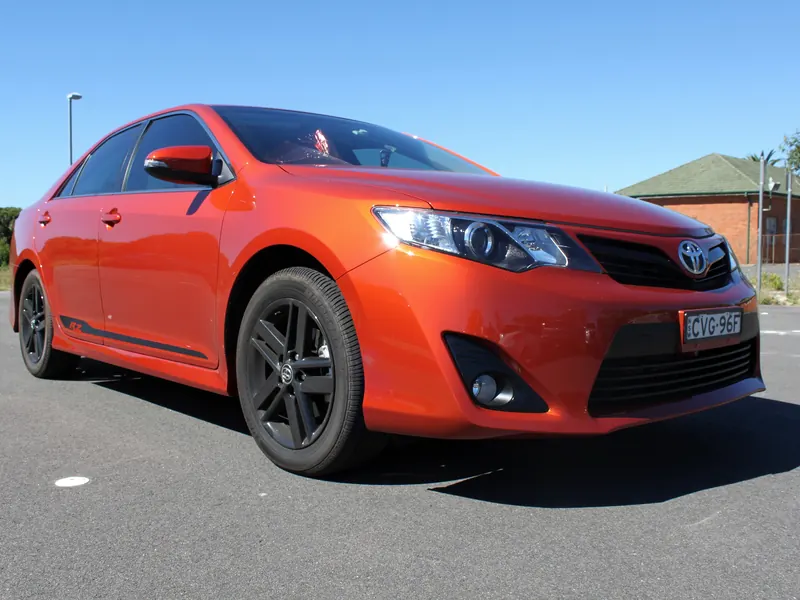
Camry assembly began in February 1987, and in July 1994 Toyota launched a new plant at Altona, in Melbourne's west. Camry production moved there in March 1995, and Camrys were being exported to the Middle East from February 1996. The highest number of exports came in 2008, when 101,668 Camrys and Aurions were shipped offshore.

Toyota ended manufacturing in Australia in October 2017, after 54 years. More than 3.4 million vehicles had rolled out of its local plants since 1963, including 2,168,104 Camrys, and Toyota said Altona would become a training and product development facility.

An orange Toyota Camry RZ sedan parked on a car park under a blue sky
A Toyota Camry RZ (ASV50R), the generation that went into production at Altona in November 2011Jeremy from Sydney, Australia · CC BY 2.0

Myth or fact?

Three things people get wrong

Open a card for the fact.

MythToyota is the founder's family name.Tap for the fact
Fact

The family name is Toyoda. In October 1936 the company changed the spelling to Toyota, for a cleaner look and sharper sound, to move away from a personal name, and because the new name takes eight strokes to write, which is thought to be auspicious.

MythThe Prius was the first hybrid car.Tap for the fact
Fact

Guinness World Records credits the Lohner-Porsche Semper Vivus, constructed in late 1900 in Vienna, as the first vehicle with a mixed combustion and electric drivetrain. Toyota calls the Prius, launched in 1997, the world's first mass-produced petrol-electric hybrid.

MythLandCruisers built the Snowy Mountains Scheme.Tap for the fact
Fact

Carsguide calls that a bit of a myth. The scheme began in 1949, and Toyota Australia says its origins here began in 1958, when contractor Thiess imported about a dozen LandCruisers.

By the numbers

Toyota in four figures

1936
the year Toyoda became Toyota
50,000,000
Corollas sold worldwide, a milestone passed in 2021
2,168,104
Camrys built in Australia, 1987 to 2017
54 years
of Toyota manufacturing in Australia, 1963 to 2017