
Peugeot

Model names with a zero in the middle began with the 201 of 1929 and became a Peugeot signature.

1 car

Studio
360°
Filter & Sort

Stock list updated 3 minutes ago

Make / Model
Price
–
Year / KMs
–
More Filters

Body

Drive

Fuel

Seats

Cylinders

Paint

Lifestyle

Origin

Discounts

SortJust Arrived (Latest)
Reset all filters
Coming soon
2015 Peugeot 308
190,000 km

Valentigney · Audincourt · Sochaux · Melbourne

The Peugeot story

From saws and pepper mills to rally champions: more than two hundred years, told in five minutes.

1810 – 1882

From saws to pepper mills

The Peugeot story begins nearly eighty years before the first Peugeot car. In 1810 the Peugeot family of Valentigney, in Franche-Comté in north-eastern France, started manufacturing with a steel foundry, which quickly turned to saws.

Other hand tools followed, then coffee grinders from around 1840 to 1842, pepper grinders in 1874 and bicycles from about 1880. In 1882 Armand Peugeot introduced his Le Grand Bi, a penny-farthing.

The lion came early too. Émile Peugeot applied for the lion trademark on 20 November 1858, and the first lion was shown walking on an arrow, standing for the speed, strength and flexibility of Peugeot saw blades.
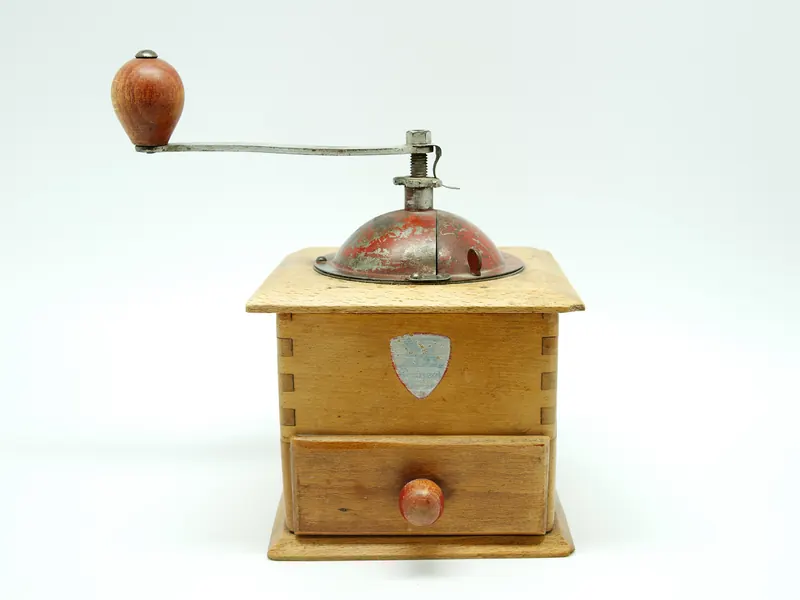
A wooden Peugeot coffee grinder with a hand crank, a red-painted hopper and a small shield badge
A Peugeot coffee grinder: the family began making them around 1840Clément Bucco-Lechat · CC BY-SA 3.0

1889 – 1899

From steam to petrol

Armand Peugeot took an early interest in the automobile, and met Gottlieb Daimler and others along the way. The first Peugeot, a three-wheeled steam car designed by Léon Serpollet, was built in 1889, and only four were made.

Steam was heavy, bulky and slow to warm up. In 1890 Peugeot switched to a four-wheeled car with a petrol engine built by Panhard under Daimler licence.

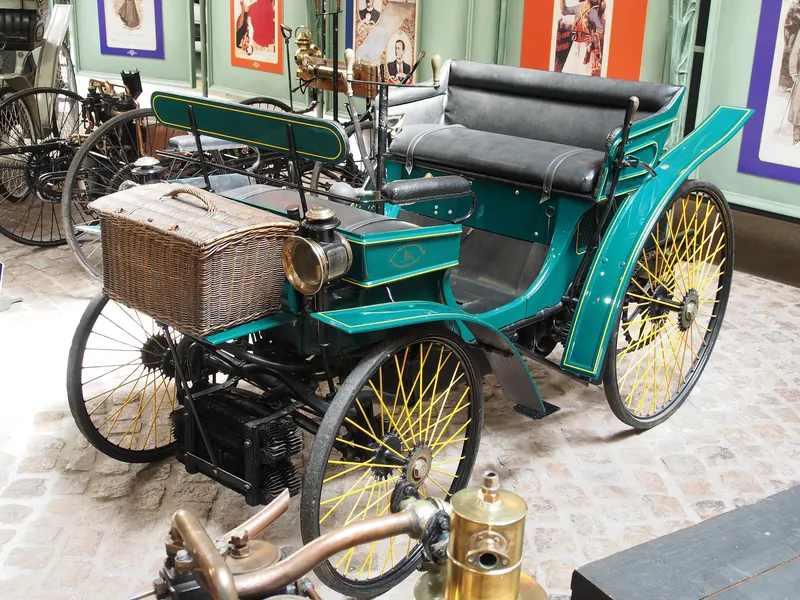
Peugeot's own account dates its first production car, the Type 3, to 1891. In 1896 Armand left the family firm to form the Société Anonyme des Automobiles Peugeot, with a new factory at Audincourt that focused entirely on cars. In 1899 it sold 300 cars, out of 1,200 for all of France.

A green and yellow 1891 Peugeot Type 3 with wire wheels and a wicker basket, on show in a museum
The Peugeot Type 3 Vis-à-Vis (1891) at the Musée de l'Aventure Peugeot, SochauxAlf van Beem · CC0

1894 – 1919

Racing from the start

Peugeot was racing within a few years of building cars. In the 1894 Paris-Rouen, often called the first motor race, Albert Lemaître was classified first in a 3 hp Peugeot.

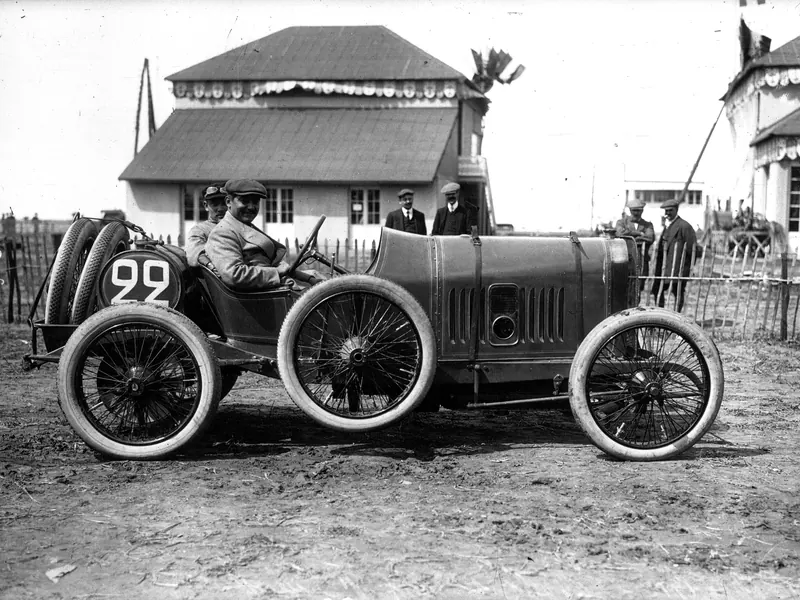
In 1912 Georges Boillot won the French Grand Prix in a Peugeot with a 7.6-litre four-cylinder engine, twin overhead camshafts and four valves per cylinder. He averaged 68.45 mph (110 km/h), despite losing third gear and making a 20-minute pit stop.

In May 1913 Jules Goux took one of the cars to Indianapolis and won at an average of 75.92 mph (122 km/h), making Peugeot the first car company based outside America to win there. Similar Peugeots won again in 1916 and 1919.

Georges Boillot and a mechanic in the number 22 Peugeot grand prix car, seen from the side, with onlookers behind a wooden fence
Georges Boillot in his Peugeot at the 1912 French Grand Prix, DieppeAgence de presse Meurisse · Public domain

1929 – 1934

The zero in the middle

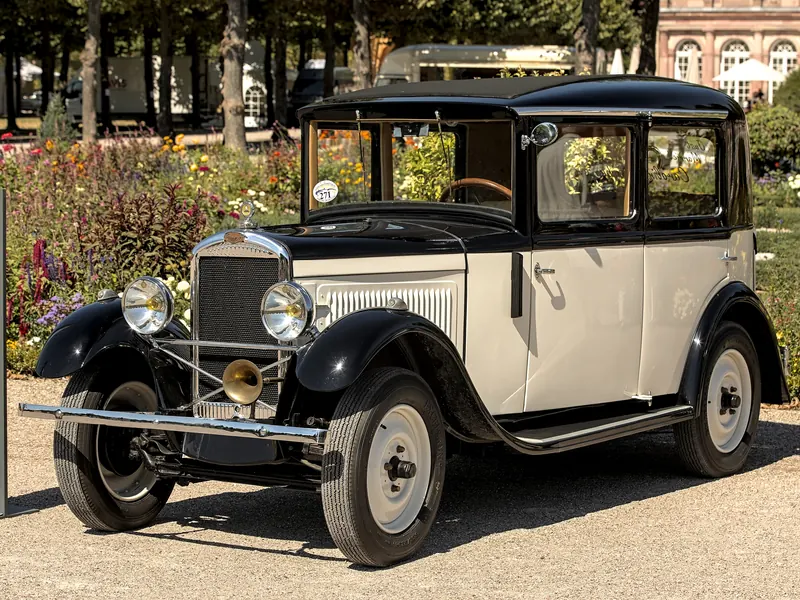
In 1929 Peugeot launched the 201, the cheapest car on the French market. It was the first to use the numbering Peugeot later registered as a trademark: three digits with a zero in the middle. In Peugeot's system the first digit signifies the car's size and the last the generation.

The Great Depression hit soon afterwards and sales slumped, but the company survived. A factory opened at Sochaux in 1910 and became the main plant in 1928. In 1934 came the 402 BL Éclipse Décapotable, described as the first convertible with a retractable hardtop.

Peugeot guarded that zero. When Porsche showed its new sports car as the 901, Peugeot objected, claiming the principle of the middle zero: in France, Porsche's history says, it owned the legal rights to all similar number sequences. Porsche's answer was to turn the zero into a one, and the 901 became the 911.

A cream and black 1930 Peugeot 201 saloon parked in front of flower beds
A 1930 Peugeot 201 saloonAlexander Migl · CC BY-SA 4.0

1983 – 1986

The 205 and the Turbo 16

Peugeot took over Chrysler's European divisions in 1978, and the 205's story starts there. Introduced on 25 February 1983, it is often credited as the car that turned Peugeot's fortunes around.

It was regularly the best-selling car in France, and British sales regularly topped 50,000 a year by the late 1980s. It won What Car? Car of the Year for 1984, and CAR magazine called it car of the decade in 1990.

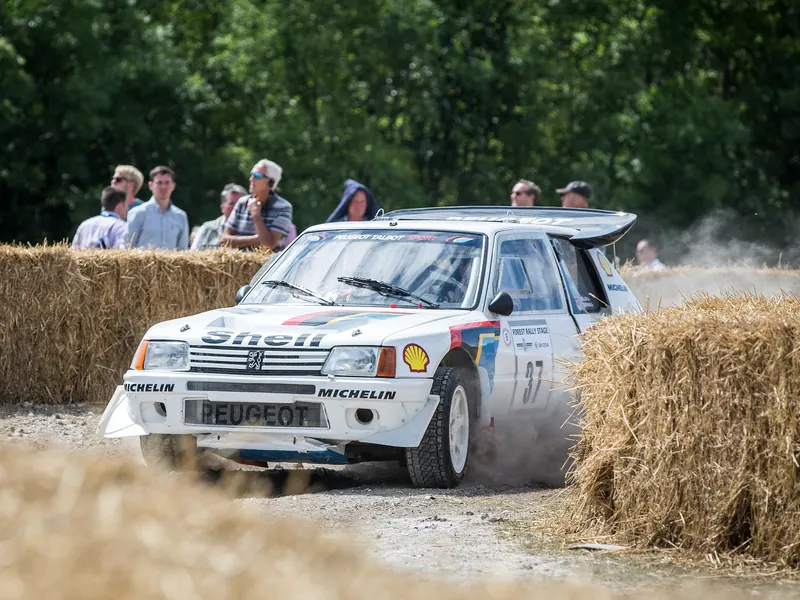
For the rally stages came the 205 Turbo 16, a mid-engined, four-wheel-drive Group B car, with 200 road versions built to qualify it. It won the World Rally Championship for manufacturers in 1985, with Timo Salonen taking the drivers' title, and again in 1986, when Juha Kankkunen was champion.

A white Peugeot 205 T16 rally car in Peugeot Talbot Sport colours sliding past straw bales
A 205 Turbo 16 at the Goodwood Festival of Speed, 2014Michelin LIVE UK · CC BY 2.0

1810 – today

Who owned Peugeot?

The name stayed the same. The company around it kept changing shape.

  1. 1810
    Peugeot family firm

    A steel foundry in Valentigney, Franche-Comté, which quickly turns to saws and other hand tools.

  2. 1896
    Société Anonyme des Automobiles Peugeot

    Armand Peugeot breaks away from Les Fils de Peugeot Frères to build cars only, with a new factory at Audincourt.

  3. 1910
    Société des Automobiles et Cycles Peugeot

    Armand's car company merges back with the family's Peugeot Frères business.

  4. 1926
    Cycles Peugeot

    The bicycle business parts ways with the car company. Family-owned Cycles Peugeot keeps building bicycles through the 20th century.

  5. 1976
    PSA Peugeot Citroën

    Peugeot, which took a stake in Citroën in 1974, takes control of it and forms PSA, short for Peugeot Société Anonyme.

  6. 1978
    Chrysler Europe

    PSA buys the failing European arm of Chrysler, formerly Rootes and Simca. Its cars are sold as Talbots; passenger-car production under that badge ends in 1987.

  7. 2014
    Dongfeng and the French state

    In a rescue, Dongfeng Motor Group and the French government each take a 13% stake. The Peugeot family's share falls from 25% to 14%.

  8. 2017
    Opel and Vauxhall

    PSA completes its purchase of Opel and Vauxhall from General Motors in August.

  9. 2021
    Stellantis

    The merger of PSA and Fiat Chrysler closes on 16 January. Peugeot is now a Stellantis brand.

1949 – 1980s

Peugeot in Australia

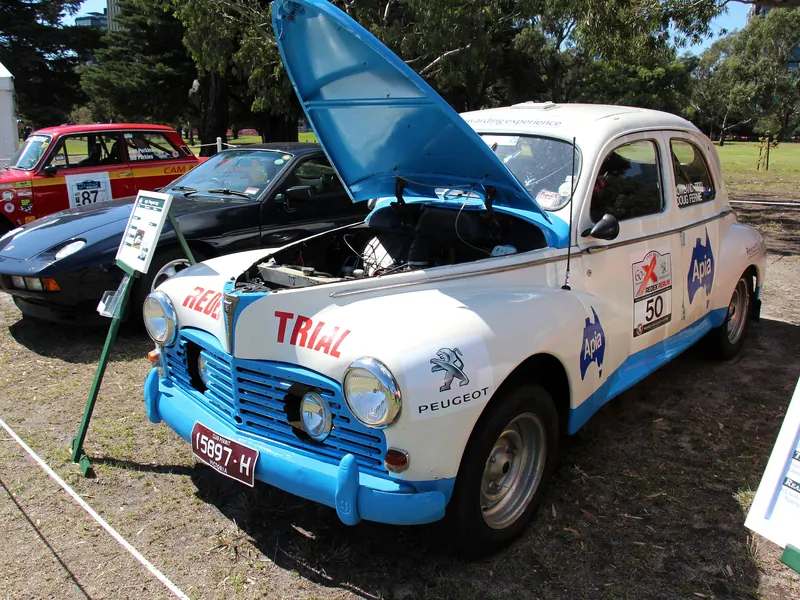
The 203 went on sale in Australia in September 1949, and from 1953 it was assembled here, the first Peugeot model to enter production in the country. That same year it won the first Round Australia Trial, the Redex Trial, driven by Ken Tubman and John Marshall.

The trial covered 6,500 miles (about 10,460 km) in less than a fortnight, and Tubman and Marshall drove a stock-standard 203 sedan. A greasy tie-breaker stage between Marulan and Bowral decided it: they lost 19 points, and the runner-up lost 20.

Three years later two Riverina graziers, Wilfred Murrell and Allan Taylor, won the first Ampol Trial in a Peugeot 403. Assembly continued with the 403, 404 and 504, and ended with the 505 in the early 1980s. Renault Australia ran the Heidelberg plant, in Melbourne, that assembled the 404 and 504.

A cream and blue 1951 Peugeot 203 in Redex Trial rally colours, bonnet open, on display on grass
A 1951 Peugeot 203 in Redex Trial rally colours, 2016Sicnag · CC BY 2.0

Myth or fact?

Three things people get wrong

Open a card for the fact.

MythPeugeot has been building cars since 1810.Tap for the fact
Fact

The family business began in 1810 with a steel foundry, then made saws, tools, coffee grinders and pepper grinders. The first Peugeot car, a steam tricycle, came in 1889, and Automobiles Peugeot was created in 1896.

MythThe Peugeot lion was drawn for the cars.Tap for the fact
Fact

The lion was registered in 1858 and appeared first on saws and other edge tools. Peugeot's own account says production cars were first decorated with the lion walking on an arrow in 1906.

MythThe Porsche 911 was always called the 911.Tap for the fact
Fact

It was shown as the 901. Peugeot objected, claiming the principle of the middle zero: a three-digit number with a zero in the middle. Porsche's own history says the zero became a one.

By the numbers

Peugeot in four figures

1810
the year the Peugeot family began manufacturing, with a steel foundry
4
examples made of Peugeot's first car, the 1889 steam tricycle
8,358,217
Peugeot 206s sold by 2012, the best-selling Peugeot of all time
10,460 km
around Australia in the 1953 Redex Trial, won by a Peugeot 203