
MINI

Turning the engine sideways and tucking the gearbox beneath it freed roughly eighty per cent of the car's floorpan for passengers and their luggage.

2 cars

Filter & Sort

Stock list updated 5 hours ago

Make / Model
Price
–
Year / KMs
–
More Filters

Body

Drive

Fuel

Seats

Cylinders

Paint

Lifestyle

Origin

Discounts

SortJust Arrived (Latest)
Reset all filters

Longbridge · Monte Carlo · Oxford · Sydney

The MINI story

From a fuel crisis in 1956 to a new MINI in 2001: the story of Mini, told in five minutes.

1956 – 1957

A crisis and a clean sheet

The Mini began with the 1956 Suez Crisis. Petrol was rationed in Britain, sales of big cars slumped, and the British Motor Corporation, whose head was Leonard Lord, suddenly needed something small and thrifty.

The job went to Alec Issigonis, a Greek-British designer born in Smyrna, now İzmir, who had already designed the Morris Minor. At the end of 1956 Lord ordered him to take a small town car, codenamed XC/9003, into production as quickly as possible.

The aim, in the Science Museum Group's words, was the smallest possible, civilised, four-seat car. By early 1957 prototypes were running.
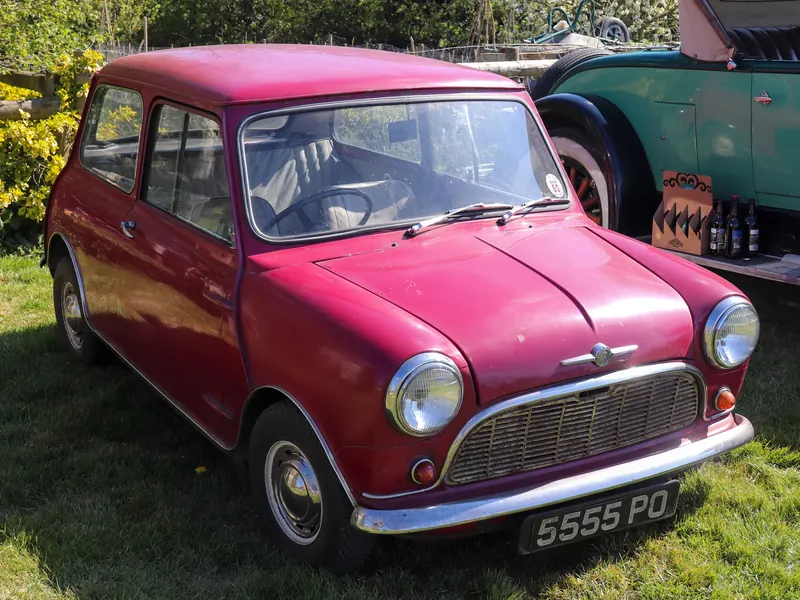
A red 1959 Morris Mini-Minor with chrome bumper and hubcaps, parked on grass
A 1959 Morris Mini-Minor 850ccVauxford · CC BY-SA 4.0

1959 – 1961

Everything in its place

The Mini was announced on 26 August 1959 and went on sale under two names: the Austin Seven and the Morris Mini-Minor. BMC sold cars under both brands, so the one new car arrived with two badges.

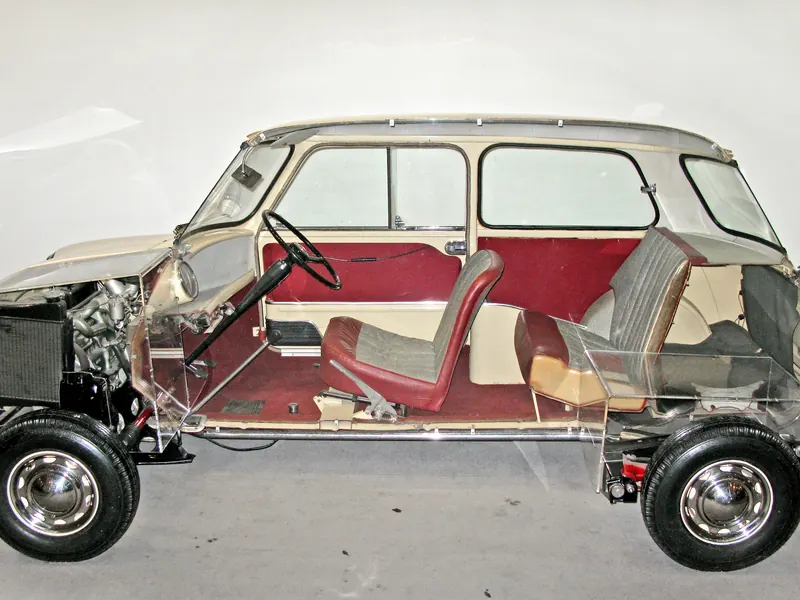
Issigonis packed it cleverly. The engine sat sideways across the car, the gearbox lived in the sump, and ten-inch wheels sat out at the corners, which let 80 per cent of the floorpan be used for passengers and luggage.

The suspension used compact rubber cones, designed by Issigonis's friend Alex Moulton. Early buyers were cautious, though, and the Science Museum Group says it took London's trendy set to make the Mini a sales success.

A sectioned Mini with its engine across the front and a four-seat cabin on show
A sectioned Mini at the Science Museum, Londongeni · CC BY-SA 4.0

1961 – 1967

The Cooper and the Monte

John Cooper, a racing-car engineer and a friend of Issigonis, saw racing potential in the Mini. Issigonis was reluctant at first, but after Cooper appealed to BMC management the two men created the Mini Cooper, which debuted in September 1961.

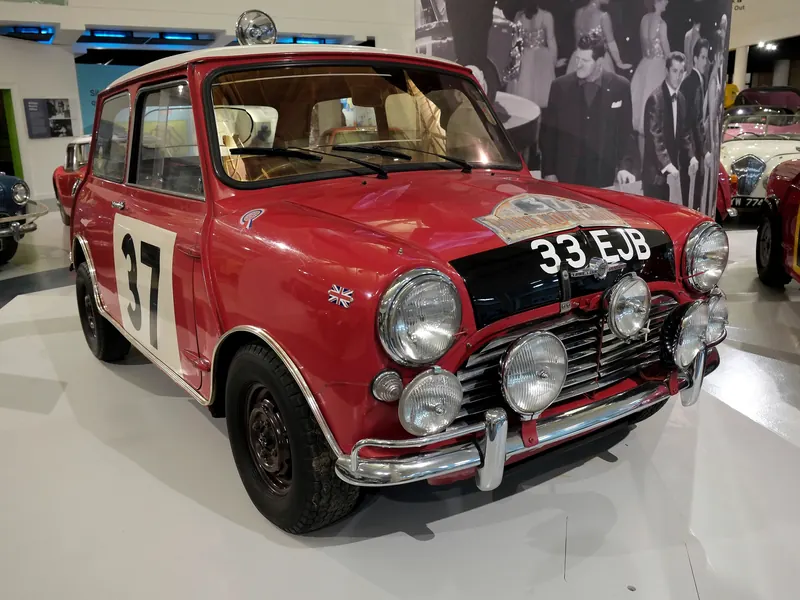
Then came Monte Carlo. In January 1964 Paddy Hopkirk and Henry Liddon won the rally in a Mini Cooper S, number 37, in a field that included a V8 Ford Falcon. Timo Mäkinen won it in 1965 and Rauno Aaltonen in 1967.

In 1966 Minis finished first, second and third, but were disqualified over their headlamps, and the win went to a Citroën. Many fans still count it as theirs, but officially the Mini won the Monte Carlo Rally three times.

A red Mini Cooper S with a white roof, spotlights and the number 37, registered 33 EJB
33 EJB, the Mini Cooper S that won the 1964 Monte Carlo Rally, at the British Motor MuseumAndrew Basterfield · CC BY-SA 2.0

1969 – 2000

The long run

In 1969 the simple name Mini replaced the separate Austin and Morris badges. The same year the film The Italian Job sent a trio of Minis through its closing car chase.

The Mini kept going while its would-be successor did not. British Leyland launched the Austin Metro in 1980 to follow it, yet the Mini outlived the Metro, and the Cooper name came back in 1990.

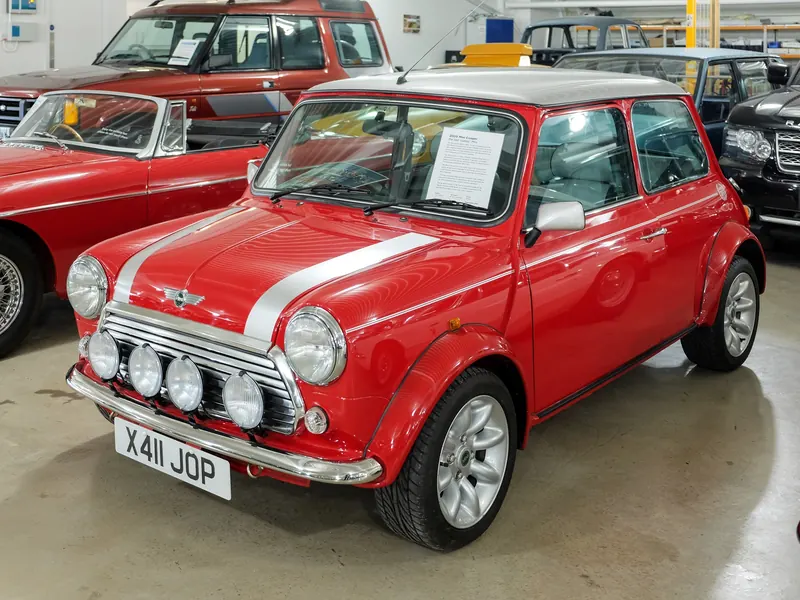
The last original Mini, a red Cooper Sport, was built at Longbridge on 4 October 2000, and the singer Lulu drove it off the line. It was the 5,387,862nd, after 41 years.

A red Rover Mini Cooper with a white roof, silver bonnet stripes and four spotlights, on show in a museum
The last original Mini, a 2000 Rover Mini Cooper, at the British Motor MuseumDeFacto · CC BY-SA 4.0

1952 – today

Who owned Mini?

From BMC to BMW, the Mini passed through a long line of owners.

  1. 1952
    British Motor Corporation

    The Austin and Morris businesses merge to form BMC. The Mini is designed here and launched in 1959 as both an Austin and a Morris.

  2. 1966
    British Motor Holdings

    BMC merges with Jaguar in September and is renamed British Motor Holdings in December.

  3. 1968
    British Leyland

    British Motor Holdings merges with Leyland Motors. In 1969 the simple name Mini replaces the separate Austin and Morris badges.

  4. 1975
    British Leyland, part-nationalised

    After a collapse, the British government creates a holding company called British Leyland.

  5. 1986
    Rover Group

    BL is renamed the Rover Group.

  6. 1988
    British Aerospace

    Rover Group becomes a subsidiary of British Aerospace.

  7. 1994
    BMW

    BMW takes control of Rover Group, owner of the Rover, MG, Mini and Land Rover brands.

  8. 2000
    BMW keeps the Mini

    BMW breaks the group up. MG and Rover go to a British consortium, Land Rover to Ford, and BMW keeps the Mini name.

  9. 2001
    BMW's MINI

    The first new MINI rolls off the line at Plant Oxford on 26 April.

1994 – today

BMW brings the name back

When BMW bought Rover Group in 1994, the Mini came with it. BMW's boss at the time, Bernd Pischetsrieder, was a relative of Alec Issigonis, and a reinvention of the Mini was probably the hottest topic of the takeover, Autocar reports.

In 2000 BMW broke Rover Group up, selling Land Rover to Ford and MG and Rover to a British consortium, but it kept the Mini. The design chosen for the new car came from BMW's Designworks studio, by the American designer Frank Stephenson.

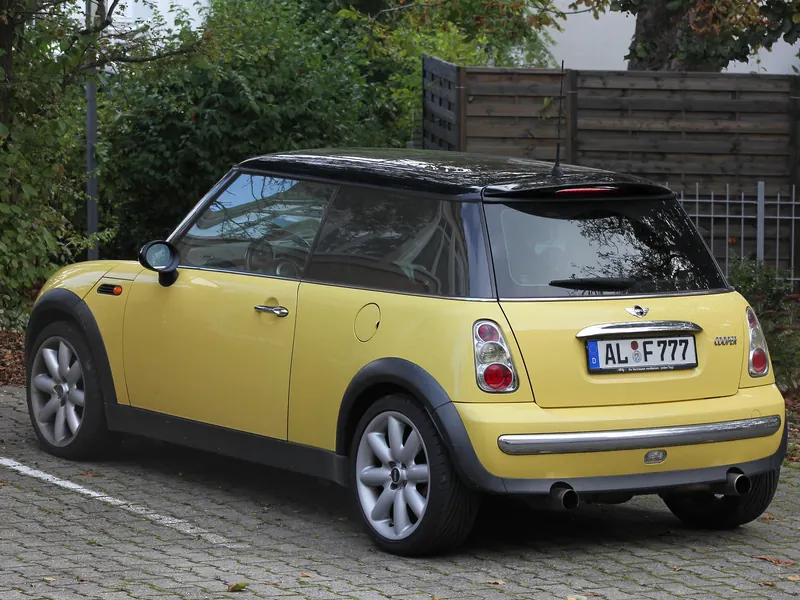
The first new MINI rolled off the line at Plant Oxford on 26 April 2001, and BMW says its UK plants had built over five million by 2021. The new car is technically unrelated to the old one, but it keeps the transverse four-cylinder, front-wheel-drive layout.

A yellow MINI Cooper with a black roof, seen from behind, parked on cobbles
A first-generation MINI Cooper, built from 2001 to 2006Lothar Spurzem · CC BY-SA 2.0 de

1961 – today

Mini in Australia

The Mini reached Australia in 1961 and was built in Sydney from the start, at BMC's Zetland factory. It was sold as the Morris 850, because the name Mini was thought to hurt sales, and within two years, one club history says, the Morris 850 and Cooper were the third best selling cars in the country.

Local engineers kept improving it. The Mini De Luxe of 1965, an all-Australian development, had wind-up windows years ahead of British Minis and was the first locally built Mini to wear the Mini badge. From 1966 Sydney also built the Mini Moke, on bigger 13-inch wheels than the British original.

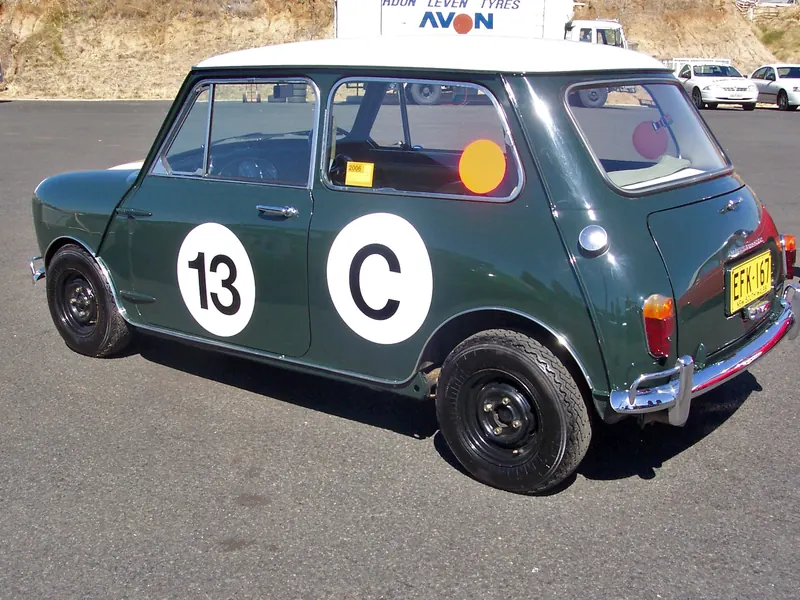
On 2 October 1966, at Mount Panorama, Rauno Aaltonen and Bob Holden won the Bathurst 500 in a Morris Cooper S, and Cooper S cars filled the first nine places. Of the 53 starters, 24 were Minis. The last Australian-built Mini sedan came off the line in 1978, and the new MINI arrived from BMW in 2002.

A dark green Morris Mini Cooper S racing car with a white roof and the number 13 on its door
The Morris Mini Cooper S that won the 1966 Bathurst 500, at Bathurst in 2006sv1ambo · CC BY 2.0

Myth or fact?

Three things people get wrong

Open a card for the fact.

MythThe Mini won four Monte Carlo Rallies.Tap for the fact
Fact

Officially, three: 1964, 1965 and 1967. In 1966 Minis finished first, second and third, but were disqualified over their headlamps, and the rally was awarded to a Citroën.

MythThe Mini was voted the car of the century.Tap for the fact
Fact

A group of European journalists named it European Car of the Century, but the global vote went to the Ford Model T. The Mini came second.

MythAlec Issigonis designed the Mini to go racing.Tap for the fact
Fact

Issigonis was reluctant at first to see the Mini as a performance car. It took his friend John Cooper, appealing to BMC management, to get the Mini Cooper made.

By the numbers

Mini in four figures

80 per cent
of the floorpan used for passengers and luggage
3
Monte Carlo Rally wins: 1964, 1965 and 1967
9
places filled by Cooper S cars at Bathurst, 1966
5,387,862
original Minis built between 1959 and 2000