Place a $1000 holding deposit on this car and we’ll take it off the market while you arrange the rest. Fully refundable subject to viewing and test drive.
Card payment processed securely by Stripe. We’ll call you to confirm as soon as it lands.
Mercedes-Benz
The three-pointed star stands for Gottlieb Daimler's ambition to build engines for use on land, on water and in the air.
Karl Benz founded Benz & Cie in Mannheim in 1883 with two business partners, Max Rose and Friedrich Esslinger. His wife Bertha, whose dowry helped to fund the business, supported him as he turned from stationary engines to a vehicle that could move.
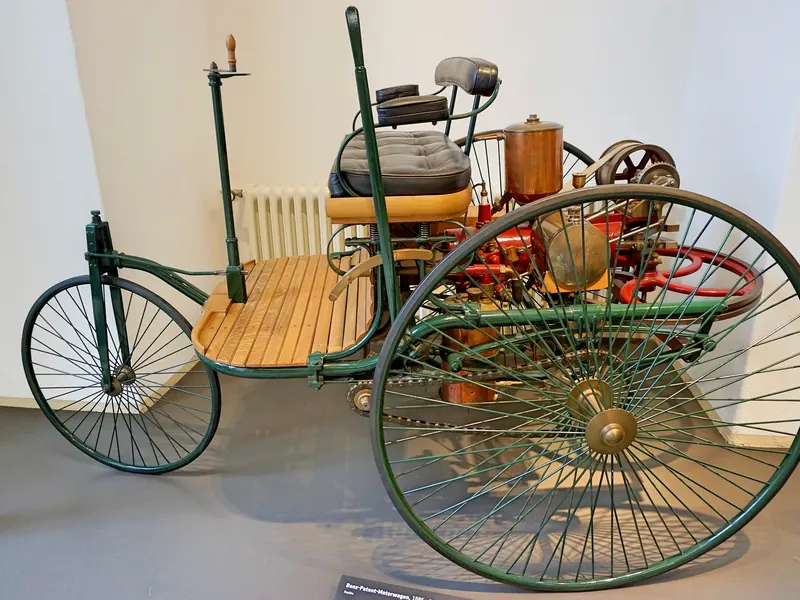
On 29 January 1886 he filed a patent for his Motorwagen, a three-wheeled vehicle with a single-cylinder petrol engine. It is widely regarded as the first practical automobile.
In August 1888 Bertha took her sons Eugen and Richard on a drive of about 106 kilometres from Mannheim to Pforzheim, without telling her husband. The car's two gears could not manage the hills, so the boys often had to push. She sent Karl a telegram when she arrived.
A replica of the 1886 Benz Patent-Motorwagen at the Verkehrsmuseum DresdenWuselig · CC BY-SA 4.0
1890
1885 – 1900
Daimler and Maybach in Cannstatt
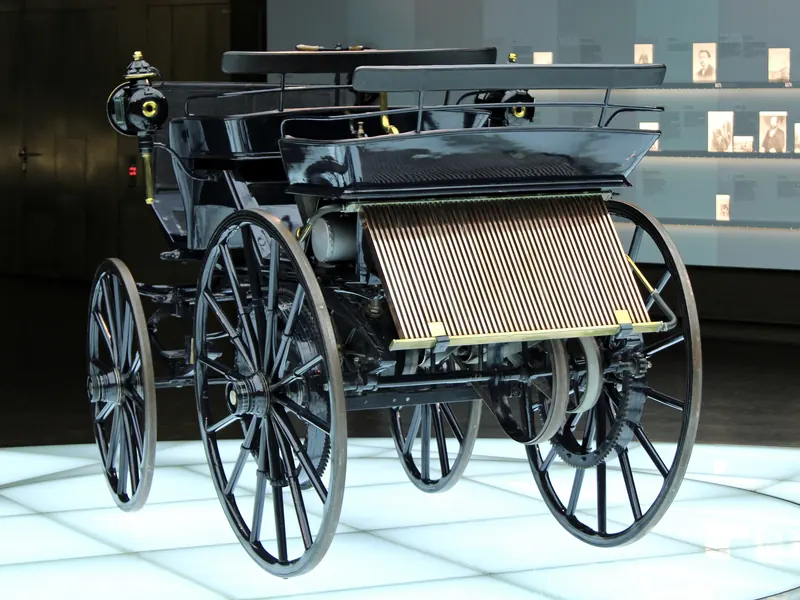
About sixty miles from Mannheim, in Bad Cannstatt, Gottlieb Daimler and Wilhelm Maybach were building engines of their own. In 1885 they fitted one to a bicycle, perhaps the first motorcycle in the world, and in 1886 they put a one-cylinder engine into a four-wheeled carriage.
Their company, Daimler-Motoren-Gesellschaft, or DMG, was founded at Cannstatt in 1890. Daimler died on 6 March 1900, and Wilhelm Maybach became general manager.
A Daimler motor carriage at the Mercedes-Benz Museum, StuttgartAlexander Migl · CC BY-SA 4.0
1901
1900 – 1903
A car called Mercédès
Emil Jellinek, a wealthy Austrian businessman living in Nice, sold DMG cars and raced them under the pseudonym Mercédès, inspired by his daughter. In 1900 he asked DMG for a longer, wider, lower car than the tall motorised coaches of the day.
Maybach first tested the new car on 22 November, and Jellinek took his first delivery on 22 December 1900. At Nice in March 1901 the Mercedes 35 hp dominated the racing, and the director of the French Automobile Club, Paul Meyan, said: "We have entered the Mercedes era."
DMG used the Mercedes name as the trademark on its production cars from 23 June 1902. The 35 hp itself is regarded as the first modern car.
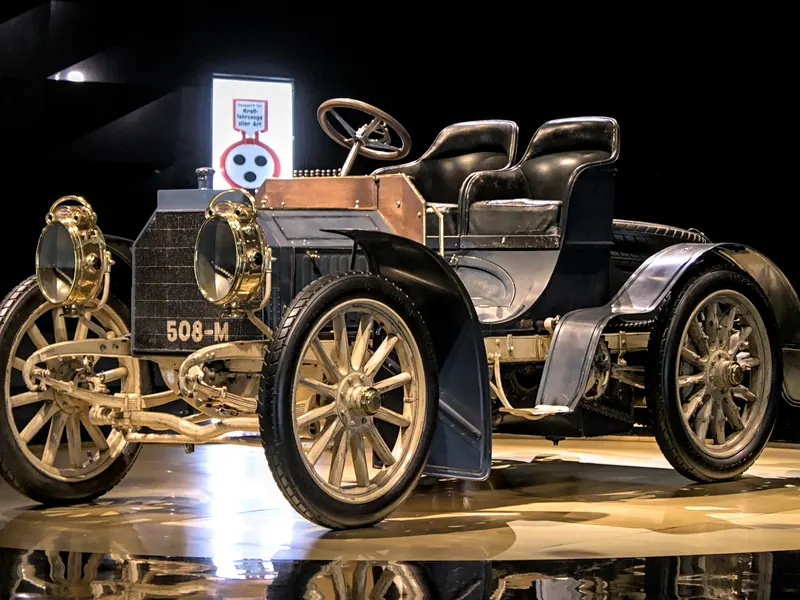
A Mercedes Simplex 40 hp, built under the Mercedes name from 1902, at the Mercedes-Benz Museum, StuttgartAlexander Migl · CC BY-SA 4.0
1926
1909 – 1945
One company, and the war years
DMG applied to protect the three-pointed star as a trademark on 24 June 1909, along with a four-pointed one that was never used. According to Mercedes-Benz, Gottlieb Daimler had once marked his family home with a star on a postcard, and after his death his sons Paul and Adolf turned the idea into a trademark. To DMG the three points stood for motorising land, water and air.
Benz & Cie and DMG, competitors until then, signed an Agreement of Mutual Interest on 1 May 1924. They merged formally on 28 June 1926 as Daimler-Benz AG and agreed that every factory would sell its cars as Mercedes-Benz.
The new badge set Daimler's star inside Benz's laurel wreath. Karl Benz stayed on the board of Daimler-Benz until his death in 1929.
From 1937 Daimler-Benz built more and more armaments, such as the LG 3000 truck and the DB 600 and DB 601 aircraft engines. Mercedes-Benz's own history says the company also used forced labourers, and that in 1944 almost half of its 63,610 employees were civilian forced labourers, prisoners of war or concentration camp detainees. After the war it admitted its links with the Nazi regime, and it joined the German Industry Foundation's initiative “Remembrance, Responsibility and Future”, whose work included humanitarian aid for former forced labourers.
A Mercedes-Benz Model S, introduced in 1927Tap Tapzz · CC0 1.0
1909 – 1979
Fast, and on the record
Benz and Mercedes-Benz cars kept coming back to record runs. The bars show the speed recorded in each run.
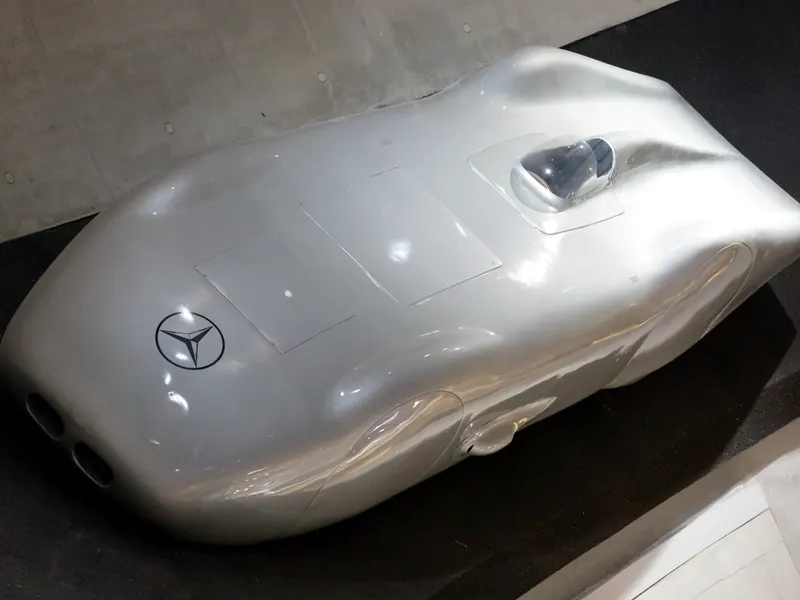
The 1938 W125 Rekordwagen at the Mercedes-Benz Museum, StuttgartMorio · CC BY-SA 3.0
Blitzen Benz1909 · 21.5 litres
203 km/h (126 mph)
Victor Hémery at Brooklands, England: 202.7 km/h over a kilometre.
W125 Rekordwagen1938 · 5.6 litres, V12
433 km/h (269 mph)
Rudolf Caracciola on the autobahn between Frankfurt and Darmstadt: 432.7 km/h over a flying kilometre.
C111-IV1979 · 4.5 litres, twin-turbo V8
404 km/h (251 mph)
Hans Liebold at Nardò, Italy: 403.9 km/h, a closed-circuit record.
Bob Burman took a Blitzen Benz to 228.1 km/h over a mile at Daytona Beach in 1911. And Caracciola's 1938 run remained the highest speed officially timed on a public road for almost 80 years.
1954
1954 – 1981
Gullwings and crumple zones
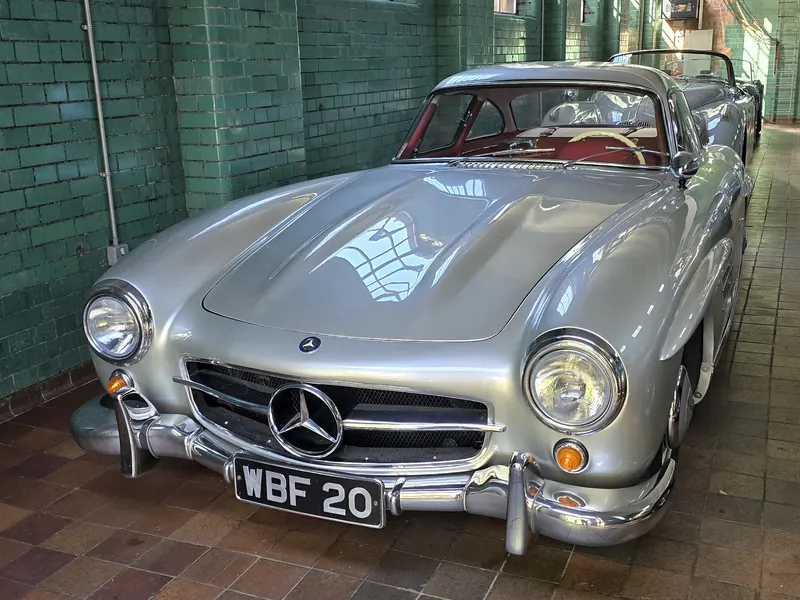
In February 1954 the 300 SL made its debut at the New York International Auto Show rather than at a European show. The idea of a toned-down racing car for road buyers had come from its US importer, Max Hoffman. The gullwing doors became iconic, and it was one of the first cars with mechanical direct fuel injection.
In 1959 the W111, nicknamed the Fintail, became the first Mercedes-Benz body built to a patent by the engineer Béla Barényi. It divided the car into a rigid passenger compartment and crumple zones at the front and rear, designed to absorb the energy of an impact.
Safety kept coming: an electronic four-wheel anti-lock braking system from Bosch was offered as an option from 1978, and an airbag as an option on the S-Class from 1981.
A 1955 Mercedes-Benz 300 SL gullwing coupéCalreyn88 · CC BY-SA 4.0
1883 – today
Who owned Mercedes-Benz?
The company behind the star has been renamed three times since 1926.
1883
Benz & Cie
Karl Benz founds the company in Mannheim with Max Rose and Friedrich Esslinger.
1890
Daimler-Motoren-Gesellschaft
Founded at Cannstatt around Gottlieb Daimler and Wilhelm Maybach's engines.
1900
Wilhelm Maybach
Becomes DMG's general manager after Daimler's death. Emil Jellinek joins its directors.
1926
Daimler-Benz AG
Benz & Cie and DMG merge on 28 June. Karl Benz stays on the board until his death in 1929.
1998
DaimlerChrysler
Daimler-Benz merges with the American Chrysler Corporation.
2007
Daimler AG
Chrysler is sold to Cerberus Capital Management, and DaimlerChrysler changes its name to Daimler AG.
2018
Li Shufu
Li Shufu of Geely takes a 9.69% stake in February, becoming the largest single shareholder.
2021
Daimler Truck
The heavy commercial vehicles business is spun off as a separate listed company, trading from 10 December.
2022
Mercedes-Benz Group
On 1 February Daimler changes its registered name to Mercedes-Benz Group AG.
1959
1900 – today
Mercedes-Benz in Australia
A Benz reached Sydney in May 1900, imported from England for a Mr Henry Vale of Auburn. From 1907 a young German immigrant, August Hoette, held the exclusive rights to sell Benz cars, from an agency on Exhibition Street in Melbourne.
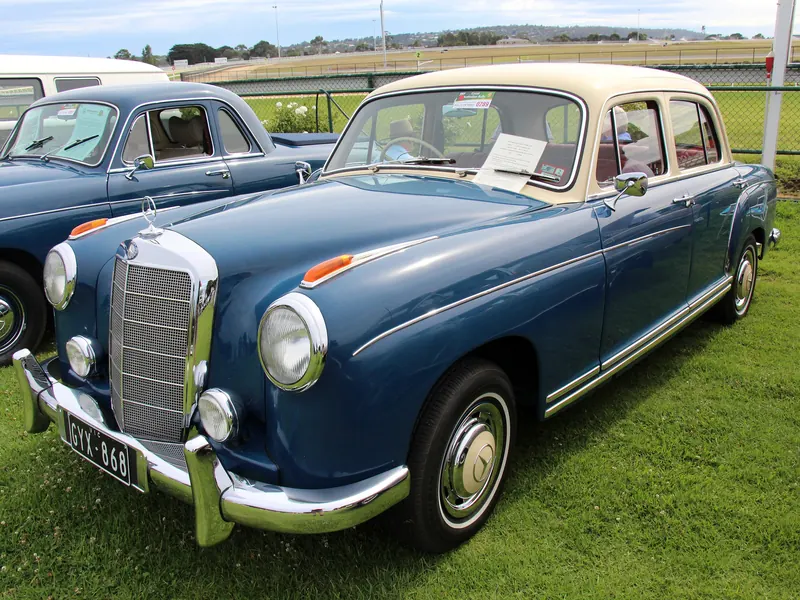
Mercedes-Benz Australia was formed on 30 July 1958, two-thirds owned by Standard Motor Products and one-third by Daimler-Benz. Cars were assembled at Standard's Port Melbourne plant, and on 12 February 1959 the first, a 220 S sedan, came off the line. Victorian Premier Henry Bolte was photographed holding its three-pointed star.
By one count almost 7,500 cars were assembled there between 1959 and 1965, in blue, green, black and three shades of grey. Mercedes-Benz moved its headquarters to Mulgrave in 1970, and in February 1978 Prime Minister Malcolm Fraser opened a truck assembly plant there.
A 1959 Mercedes-Benz 220 S sedanSicnag · CC BY 2.0
Myth or fact?
Three things people get wrong
Open a card for the fact.
MythThe Silver Arrows got their name when Mercedes scraped the white paint off in 1934.Tap for the fact
Fact
That is the story told by racing manager Alfred Neubauer and driver Manfred von Brauchitsch, but it did not appear until 1958 and no reference to it has been found in contemporary sources. Von Brauchitsch had also raced a streamlined silver SSKL at the AVUS in 1932, which live radio coverage called a Silver Arrow.
MythKarl Benz and Gottlieb Daimler built Mercedes-Benz together.Tap for the fact
Fact
Daimler never met Karl Benz during the period of invention. Daimler died in 1900, and their companies merged only in 1926, with Benz alive to see it.
MythKarl Benz was granted his patent on 29 January 1886.Tap for the fact
Fact
That was the day he filed the application. It was granted on 2 November 1886, and a granted patent takes the date of its filing.
Quick quiz
Guess the year
When did Karl Benz file his patent for the motor car?
1886: he filed on 29 January, and the patent was granted on 2 November.
When did Benz & Cie and DMG merge?
1926, on 28 June. They agreed that their cars would all be sold as Mercedes-Benz.
When did the first Mercedes-Benz come off the line at Port Melbourne?
1959, on 12 February. It was a 220 S, and Premier Henry Bolte held its star.
By the numbers
Mercedes-Benz in four figures
1886
Karl Benz files his motor car patent
106 km
Bertha Benz's drive from Mannheim to Pforzheim, 1888