
Holden

The lion and stone badge references a fable in which a lion rolling a stone inspired humans to invent the wheel.

1 car

Filter & Sort

Stock list updated 7 hours ago

Make / Model
Price
–
Year / KMs
–
More Filters

Body

Drive

Fuel

Seats

Cylinders

Paint

Lifestyle

Origin

Discounts

SortJust Arrived (Latest)
Reset all filters

The Holden story

The Holden story: the one-minute overview, narrated by Michi1:05

1856 – 1910

A saddlery in Adelaide

Holden's own heritage page says the company was established as a saddle maker in 1856. James Alexander Holden had emigrated from Walsall, England, to South Australia in 1852, and founded J. A. Holden & Co., a saddlery in Adelaide.

His eldest son, Henry James Holden, became a partner in 1879. In 1885 the firm joined the carriage builder Henry Frost to form Holden & Frost Limited, making carriages, harnesses, saddlery and travel goods.

In 1905 Henry's eldest son Edward joined the business. Holden began turning its manufacturing skills to the growing motor vehicle industry, with a motor trimming department set up in 1910.
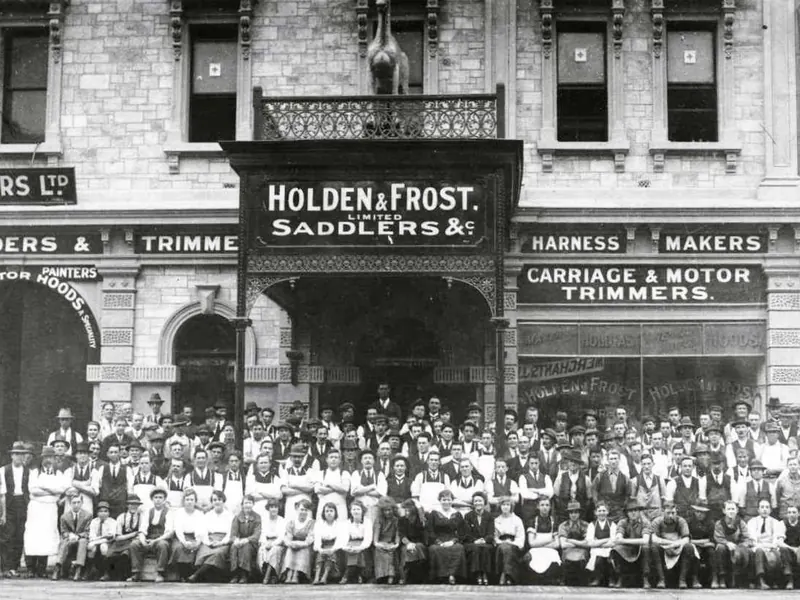
Staff gathered outside the Holden & Frost building in Adelaide, under signs reading Saddlers and Carriage & Motor Trimmers
Holden & Frost, Grenfell Street, Adelaide, about 1915Unknown photographer, via State Library of South Australia · Public domain

1919 – 1931

Bodies for everyone

The First World War limited imports to one complete car for every three chassis, so Holden & Frost began making car bodies on a large scale. Holden's Motor Body Builders was established in 1919 at 400 King William Street, Adelaide.

It built bodies for Ford, Buick, Studebaker, Chevrolet and many other makes. By 1923 it was making more than half of all the car bodies in Australia, and it went on to become General Motors' exclusive body supplier here.

Then came the Depression, and production fell from 34,000 units in 1930 to just 1,651 a year later. In 1931 General Motors bought the company and merged it with General Motors (Australia) to form General Motors-Holden's, with Edward Holden as first chairman.

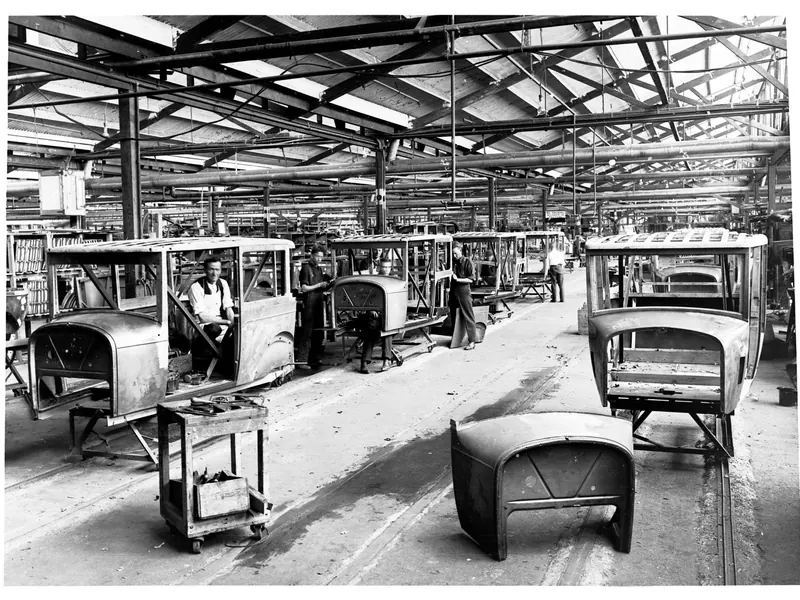
Rows of wooden-framed car bodies being assembled inside a long factory shed, with workers among them
Car bodies at Holden's Woodville works, South Australia, 1928State Government Photographer, via History Trust of South Australia · CC0

1936 – 1953

Australia's own car

Holden's factory at Fishermans Bend in Port Melbourne was opened by Prime Minister Joseph Lyons on 5 November 1936. In the Second World War the company made parts for Beaufort bombers and led the program that built about 1,300 Gipsy Major aero engines.

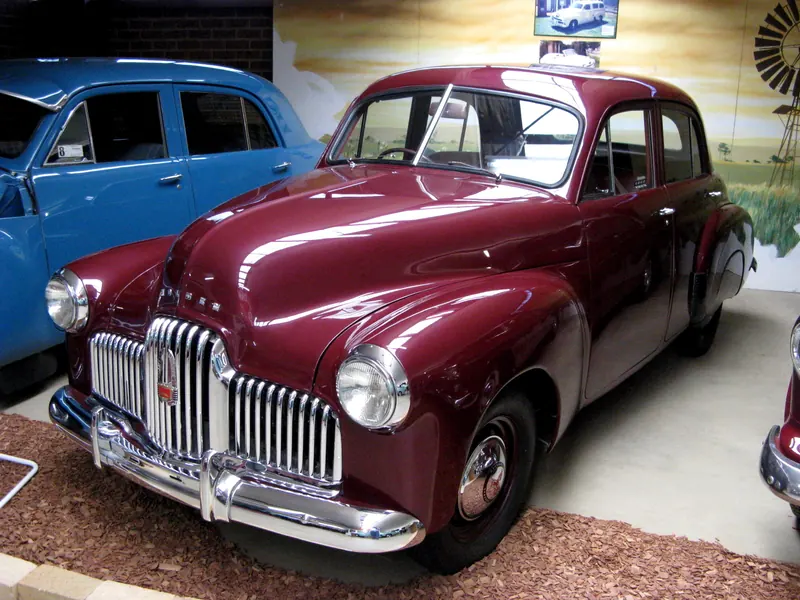
In 1944 Prime Minister Ben Chifley challenged the car industry to produce a car made entirely in Australia. On 29 November 1948 he launched the result at Fishermans Bend: the Holden 48-215, a six-cylinder sedan that the National Archives calls the first mass-produced Australian-made car.

The bodies were built at Woodville in South Australia and sent to Victoria for assembly. By the launch 18,000 people had already paid a deposit, and 120,402 were built between 1948 and 1953.

A maroon 1948 Holden 48-215 sedan on display in a museum
A 1948 Holden 48-215Museumsfotografierer · Public domain

1968 – 1971

Kingswood and Monaro

The HK series of January 1968 was the first Holden to offer a V8, a Chevrolet engine imported from Canada. The mainstream Holden Special was renamed Kingswood, and the basic Standard became the Belmont.

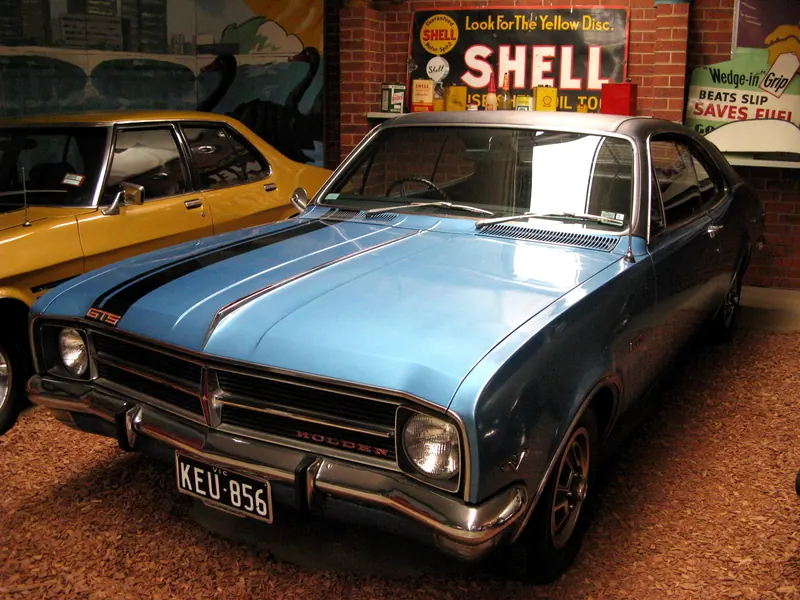
The Monaro followed in July 1968. It was the first Holden coupe and the first Holden to win Bathurst, and it took its name from the shire in the Snowy Mountains.

In 1969 the HT carried Holden's first Australian-developed V8. The HQ Kingswood of 1971 would be built 485,650 times, making it the second most-built Holden model after the VE Commodore.

A light blue 1968 Holden HK Monaro GTS coupe with black bonnet stripes, parked in a museum
A 1968 Holden HK Monaro GTS coupeMuseumsfotografierer · Public domain

1969 – 1987

Peter Brock at Bathurst

The Holden Dealer Team was formed in 1969, and its manager Harry Firth gave Peter Brock his break that year: a drive in a Monaro GTS 350 at Bathurst. At his first attempt Brock finished third.

In 1972, driving a Torana XU-1, he won his first Bathurst. He would win the race nine times in all, in 1972, 1975, 1978, 1979, 1980, 1982, 1983, 1984 and 1987, a feat that has not been equalled.

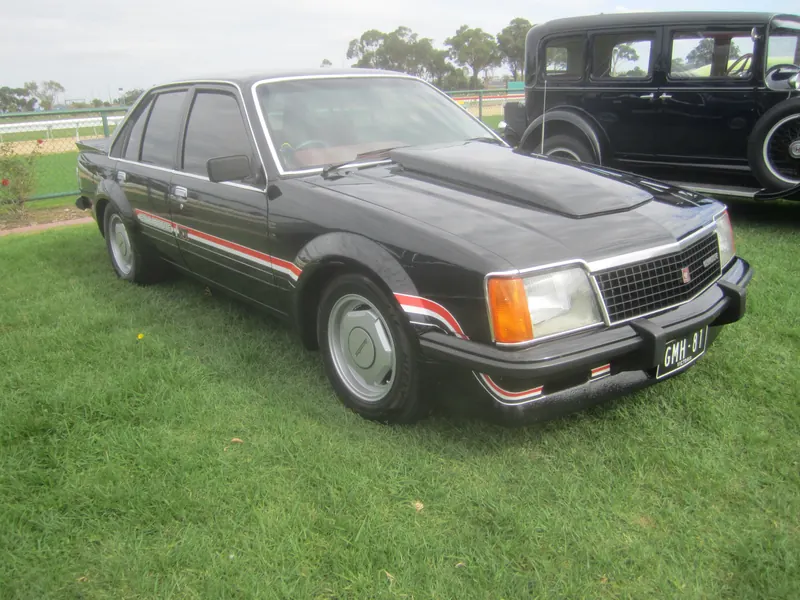
His 1979 win, with Jim Richards in an A9X Torana, came by a record six laps. From the mid-1970s he raced under the number 05, a nod to Victoria's 0.05 per cent blood alcohol limit.

A black 1980 Holden VC Commodore with HDT stripes, parked on grass
A 1980 Holden VC HDT Commodore 5.0Sicnag · CC BY 2.0

1978 – 2017

The Commodore

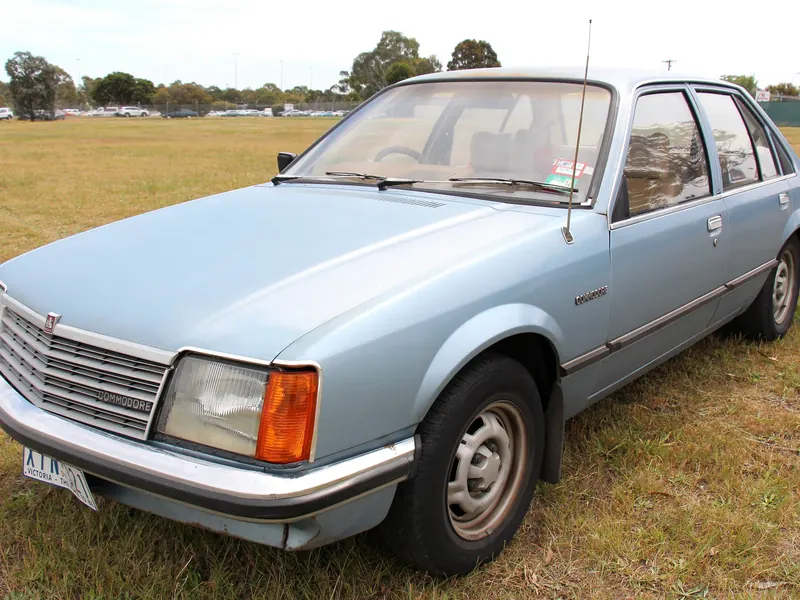
Holden launched the Commodore on 26 October 1978, and the first cars reached showrooms on 13 November. The VB was based on the 1977 Opel Rekord E, with the front of the Opel Senator grafted on to make room for Holden's larger six-cylinder and V8 engines.

Wheels reported it as 130 kilograms lighter than a comparable Kingswood. In 1979, its first full year of production, the VB became Australia's number one selling car.

The name stayed on Holden's Australian-built family car for almost four decades. The VE of 2006 was Holden's first clean-sheet design since 1971, and with 520,000 built it is the most-built Holden model.

A pale blue 1979 Holden VB Commodore sedan parked on dry grass
A 1979 Holden VB CommodoreSicnag · CC BY 2.0

1856 – 2020

Who owned Holden?

Holden began as a family firm in Adelaide, and from 1931 it was part of General Motors.

  1. 1856
    J. A. Holden & Co.

    James Alexander Holden's saddlery in Adelaide.

  2. 1879
    J. A. Holden & Son

    His eldest son, Henry James Holden, becomes a partner.

  3. 1885
    Holden & Frost

    The firm joins the carriage builder Henry Frost.

  4. 1919
    Holden's Motor Body Builders

    Set up with Henry J. Holden as chairman and Edward as managing director.

  5. 1926
    General Motors (Australia)

    Formed with its headquarters in Melbourne.

  6. 1931
    General Motors-Holden's

    GM buys Holden's Motor Body Builders and merges it with General Motors (Australia). Edward Holden is the first chairman.

  7. 1998
    Holden Ltd

    The company is renamed Holden Ltd.

  8. 2005
    GM Holden Ltd

    Renamed on 18 May, as the company moves into its new headquarters in Port Melbourne.

  9. 2017
    An importer

    With manufacturing over, Holden sells imported vehicles only.

  10. 2020
    GM Specialty Vehicles

    The Holden brand is retired at the end of the year, and GM Specialty Vehicles takes its place.

2013 – 2020

How the story ended

In December 2013 Holden announced it would stop making cars and engines in Australia by the end of 2017. On 29 November 2016 the last Holden engine was built at Fishermans Bend, in Port Melbourne, after 76 years of engine manufacture.

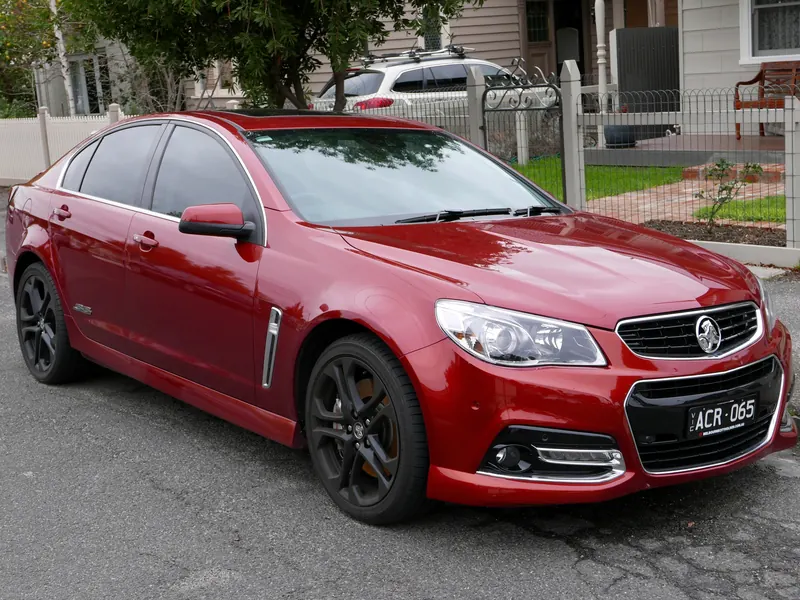
On 20 October 2017 the last Holden was finished at Elizabeth, in South Australia: a red Commodore SS-V Redline sedan with a manual gearbox. That day 945 people were employed at the plant, and Holden had built 7,687,675 vehicles in Australia between 1948 and 2017.

Holden then carried on as an importer for its last three years. In February 2020 General Motors announced it would retire the Holden brand by 2021, and the brand ended on the last day of 2020, with GM Specialty Vehicles taking its place.

A red Holden Commodore SS V Redline sedan parked on a suburban street
A 2015 Holden Commodore VF SS-V Redline sedanOSX · Public domain

Myth or fact?

Three things people get wrong

Open a card for the fact.

MythThe Holden 48-215 was the first car built in Australia.Tap for the fact
Fact

Cars were being built in Australia long before 1948. A Melbourne firm, Tarrant Motor and Engineering, built the first vehicle with an internal combustion engine in Australia in 1901. What was new in 1948, says the National Archives, was a mass-produced Australian-made car.

MythThe Commodore was just an Opel with a Holden badge.Tap for the fact
Fact

The VB did start as the Opel Rekord E, with the front of the Opel Senator to fit Holden's engines. But in 1978 Holden said 65 per cent of its parts were designed and developed by Holden, and Wheels reported local content at 85 to 88 per cent.

MythHolden ended when the last Commodore was built in 2017.Tap for the fact
Fact

Manufacturing ended at Elizabeth on 20 October 2017, but Holden carried on selling imported vehicles for its last three years. General Motors announced the brand's retirement in February 2020, and it ended on the last day of 2020.

By the numbers

Holden in four figures

120,402
Holden 48-215s built between 1948 and 1953
76 years
of Holden engine manufacture, ending at Fishermans Bend in 2016
9
Bathurst wins for Peter Brock, 1972 to 1987
7,687,675
vehicles built in Australia, 1948 to 2017