
Audi

The four interlocking rings mark a 1932 merger of four Saxon car makers: Audi, DKW, Horch and Wanderer, which together became Auto Union.

4 cars

Filter & Sort

Stock list updated 5 hours ago

Make / Model
Price
–
Year / KMs
–
More Filters

Body

Drive

Fuel

Seats

Cylinders

Paint

Lifestyle

Origin

Discounts

SortJust Arrived (Latest)
Reset all filters

The Audi story

The Audi story: the one-minute overview, narrated by Michi1:04

1899 – 1914

A Latin name for a second chance

August Horch was one of Germany's car-making pioneers. He founded A. Horch & Cie. in Cologne on 14 November 1899, moved it to Saxony in 1902, and in 1904 turned it into a joint-stock company in Zwickau.

In 1909 he left after differences of opinion and started a new car company, also in Zwickau. His old firm held the Horch name, so he translated it: Horch is German for listen, and the Latin for the same command is audi. The first car with the new name was delivered in May 1910.

The new Audis proved themselves quickly. They won the Austrian Alpine Rally, then the toughest long-distance event of its kind, three years running, in 1912, 1913 and 1914.
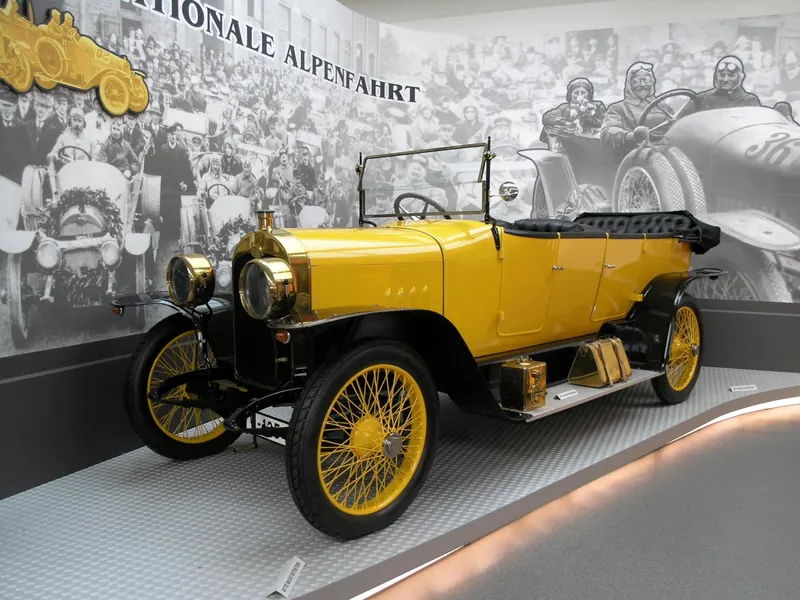
A yellow 1913 Audi Type C open tourer displayed in front of a mural of the Austrian Alpine Trial
A 1913 Audi Type C 14/35 PS, the Alpensieger (Alps champion), at the August Horch Museum, ZwickauMatěj Baťha · CC BY-SA 2.5

1928 – 1939

Four companies, four rings

Jörgen Skafte Rasmussen, the Danish-born owner of DKW, bought Audi in 1928. DKW was by then the world's largest motorcycle manufacturer.

On 29 June 1932, on the initiative of Saxony's state bank, Audi, DKW, Horch and the car division of Wanderer merged to form Auto Union AG, the second-largest automotive group in Germany. Its emblem was four interlocking rings, one for each of the founding companies.

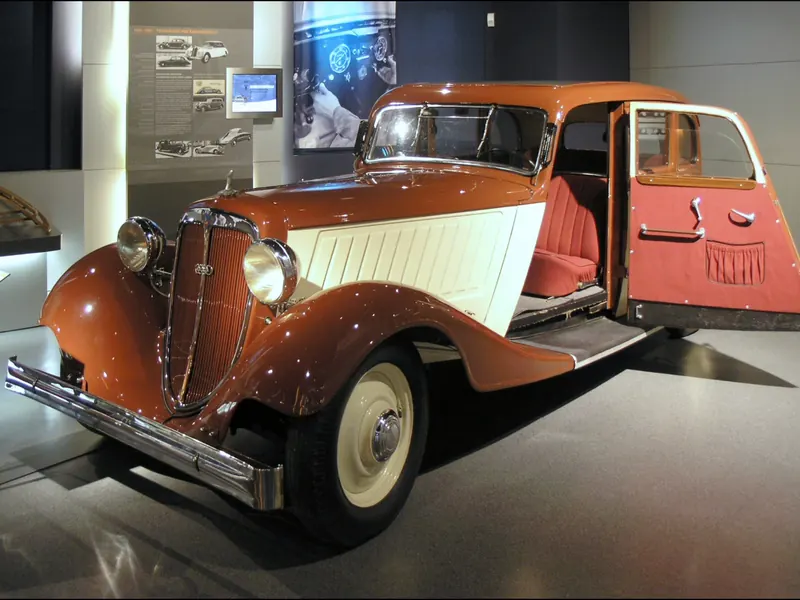
Each brand had its own patch: DKW made motorcycles and small cars, Wanderer mid-size cars, Audi upper mid-size cars and Horch large luxury cars. Auto Union's share of car registrations in Germany reached 25.3 per cent in 1937, most of it DKWs.

A brown and cream 1935 Audi 225 roadster with its door open, displayed in a museum
A 1935 Audi 225 roadster at the August Horch Museum, ZwickauMatěj Baťha · CC BY-SA 2.5

1934 – 1937

The Silver Arrows

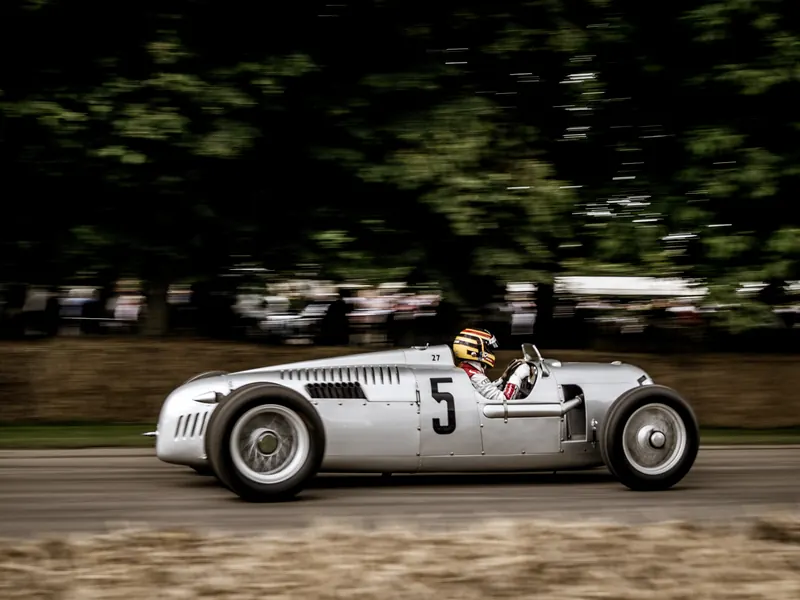
Auto Union's racing cars were designed by Ferdinand Porsche, with the engine behind the driver, and spent the 1930s duelling with Mercedes-Benz. The bars show three of their recorded speeds.

A silver Auto Union Type C racing car with the number 5 driving fast, the background blurred
An Auto Union Type C at the Goodwood Festival of Speed, 2016Mark Ireland · CC BY 2.0
  1. Type A1934 · 4.4 litres, V16
    217 km/h (135 mph)

    Hans Stuck at the Avus in Berlin: three world records on 6 March, among them a one-hour average of 217 km/h from a standing start.

  2. Lucca1935 · about 5 litres, V16
    320 km/h (199 mph)

    Hans Stuck near Lucca, Italy: 320.267 km/h average for a flying-start mile, and a measured 326.975 km/h over a kilometre.

  3. Type C Streamliner1937 · 6.0 litres, V16
    406 km/h (252 mph)

    Bernd Rosemeyer on the autobahn between Frankfurt and Darmstadt, October 1937: the first person to drive a car on a public motorway at more than 400 kilometres an hour.

In 1936 Bernd Rosemeyer won the European Championship in a Type C. He died in January 1938 on a further record attempt on the same stretch of autobahn.

1945 – 1965

A new start in Ingolstadt

During the war Auto Union was involved in the production of armaments and war supplies, and Audi's own company history records that it employed around 17,300 forced labourers and 3,700 prisoners from satellite camps of the Flossenbürg concentration camp. When the war ended, Soviet occupation forces expropriated the company and largely dismantled its factories in Saxony, and in 1948 it was struck off the commercial register in Chemnitz.

Some managers had by then fled west, and in late 1945 they set up a spare-parts depot in Ingolstadt, an old Bavarian garrison town with plenty of empty military buildings. On 3 September 1949 Auto Union GmbH was formed there to carry on the four-ring tradition.

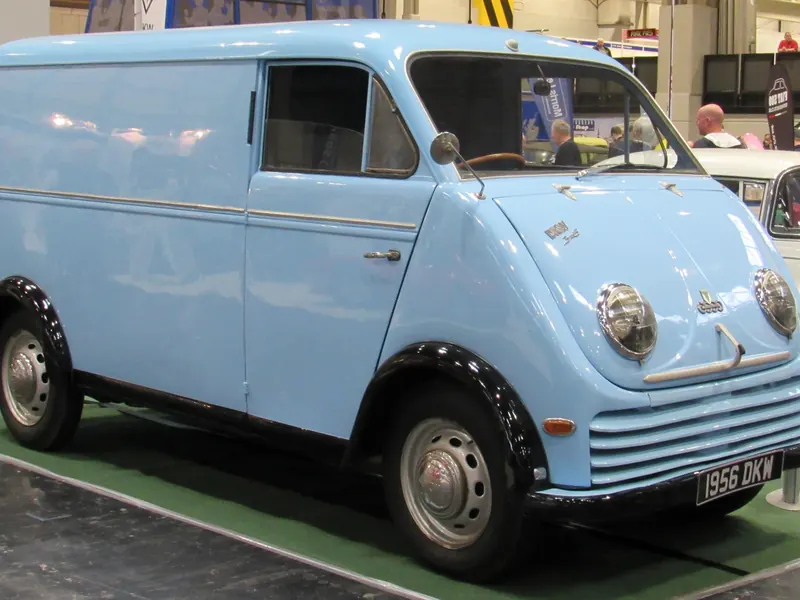
Its first products were DKW motorcycles and the DKW F 89 L delivery van, which had been shown at the Hanover Export Trade Fair in May 1949. Daimler-Benz bought about 88 per cent of Auto Union in 1958, but the two-stroke DKWs were losing ground. Ownership passed in stages to Volkswagen from the end of 1964, and in August 1965 the Audi name returned on a new car with Ingolstadt's first four-stroke engine.

A pale blue 1950s DKW Schnellaster delivery van with rounded bodywork, on show indoors
A 1956 DKW F 89 L Schnellaster vanVauxford · CC BY-SA 4.0

1965 – 1979

A secret Audi and a slogan

Volkswagen's new subsidiary was at first barred from developing its own cars, and there was talk in Wolfsburg of using Ingolstadt only to build Beetles. Ludwig Kraus, Auto Union's head of development, went ahead in secret anyway.

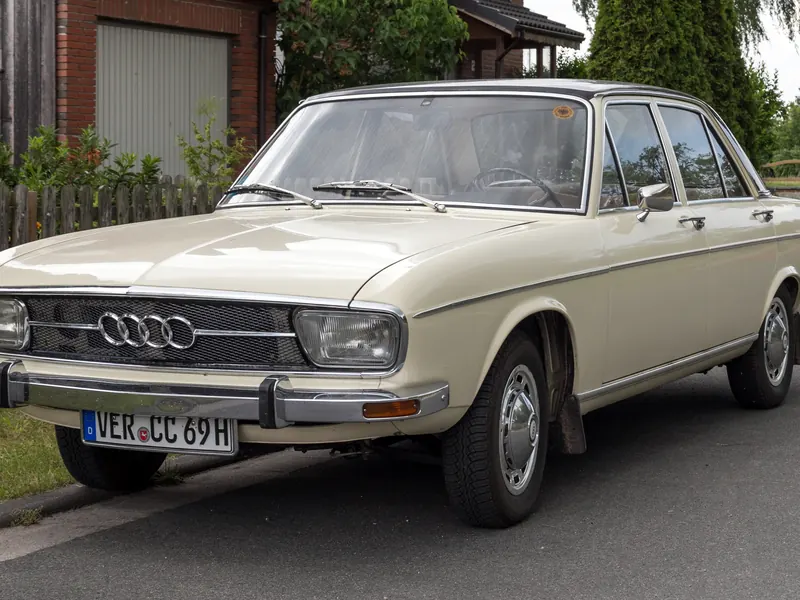
The result, the Audi 100, was shown to the international press in Ingolstadt in November 1968. It was the first model not based on DKW technology, and its success helped Auto Union keep its independence within the Volkswagen Group.

In 1969 Auto Union merged with NSU of Neckarsulm, maker of the Wankel-engined Ro 80, to form Audi NSU Auto Union AG. In 1971 the new company adopted the slogan Vorsprung durch Technik, translated as progress through technology, and the Audi 80 followed in 1972.

A cream-coloured first-generation Audi 100 saloon parked on a street
A first-generation Audi 100 saloonJoachimKohler-HB · CC BY-SA 4.0

1977 – 1987

Four driven wheels

The idea is credited to chassis engineer Jörg Bensinger, who in 1977 found that Volkswagen's Iltis military vehicle outperformed other cars in snow tests. Audi unveiled the quattro at the Geneva Motor Show in March 1980. With permanent all-wheel drive and two manually lockable differentials, Audi calls it the first high-volume car with permanent all-wheel drive.

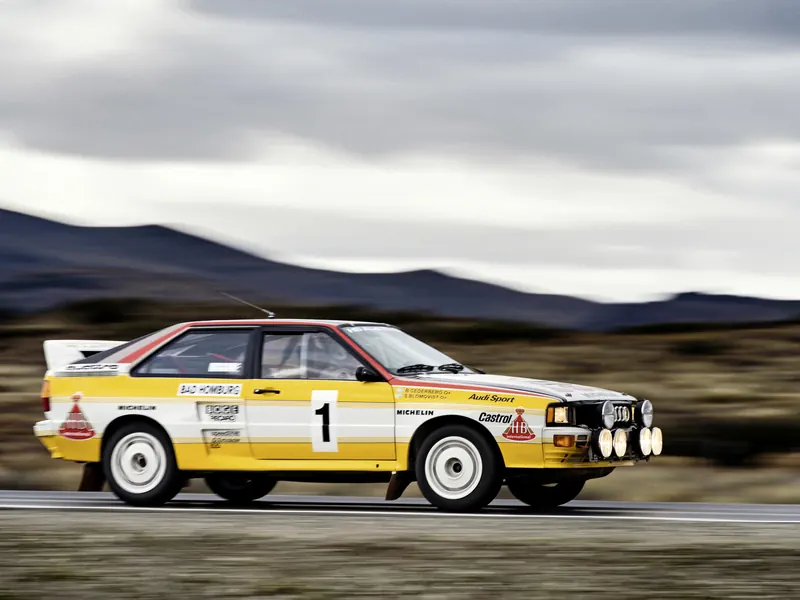
Rallying made the point. The quattro made its debut at the Monte Carlo Rally in 1981, Hannu Mikkola won the Swedish Rally in it shortly afterwards, and at the Sanremo Rally Michèle Mouton took the first victory by a woman in a World Championship event.

Audi won the manufacturers' title in 1982, the first German brand to do so, and Mikkola took the drivers' title in 1983. In 1984 Audi won both, with Stig Blomqvist as champion, and in 1987 Walter Röhrl became the first driver to climb Pikes Peak in under eleven minutes, in an Audi Sport quattro S1 E2.

A yellow, white and red Audi quattro rally car at speed on a road, 1983 season
An Audi quattro A2 rally car, 1983Audi Sverige · CC BY 3.0

1899 – today

Who owned Audi?

A Cologne workshop, a Saxon merger, a Soviet seizure and a fresh start in Bavaria: the Audi badge has taken a long road to its current owner.

  1. 1899
    A. Horch & Cie.

    August Horch founds his first company in Cologne. It later moves to Zwickau, in Saxony.

  2. 1909
    Audi, Zwickau

    Horch leaves and founds a second car company. It is entered in the register as Audi in 1910.

  3. 1928
    Rasmussen and DKW

    Jörgen Skafte Rasmussen, owner of DKW, buys Audi.

  4. 1932
    Auto Union AG

    Audi, DKW, Horch and Wanderer's car division join in Chemnitz. Saxony's state bank holds 80 per cent.

  5. 1945
    Soviet occupation

    Auto Union's Saxon factories are expropriated and dismantled. The company is struck off the register in 1948.

  6. 1949
    Auto Union GmbH

    A new company is formed in Ingolstadt, Bavaria, to carry on the four-ring tradition.

  7. 1958
    Daimler-Benz

    Buys about 88 per cent of Auto Union in April, and the rest the following year.

  8. 1965
    Volkswagen

    Ownership passes to Volkswagenwerk AG in stages from the end of 1964. The Audi name returns.

  9. 1969
    Audi NSU Auto Union

    Auto Union merges with NSU of Neckarsulm. Both were Volkswagen subsidiaries.

  10. 1985
    AUDI AG

    The company takes the brand's name and moves its head office from Neckarsulm to Ingolstadt.

  11. today
    Volkswagen Group

    Audi is a wholly owned subsidiary of the Volkswagen Group, with its head office in Ingolstadt.

1989 – 2014

Diesel, aluminium and Le Mans

On the road, the Audi 100 TDI arrived in 1989, which Audi describes as the first diesel passenger car with direct fuel injection. In 1994 came the A8, developed from an all-aluminium Audi Space Frame design study.

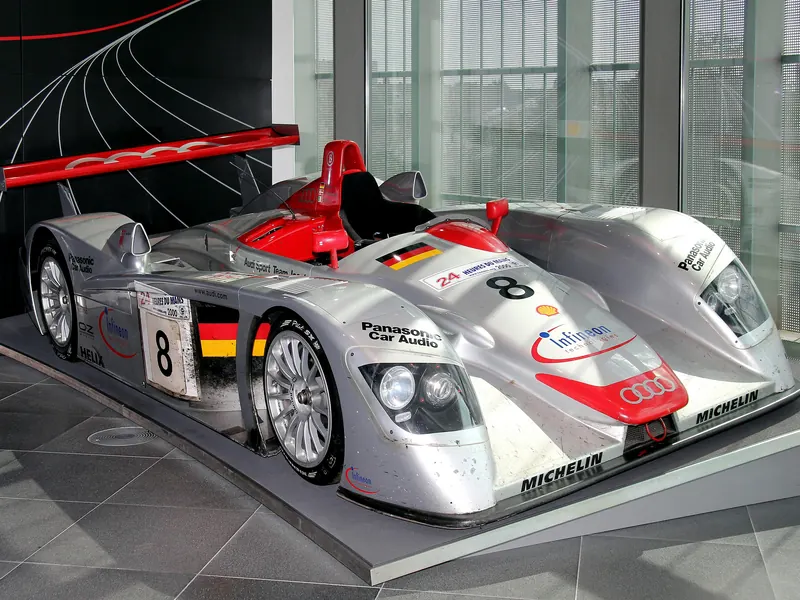
Audi entered the Le Mans 24 Hours in 1999 and won it in 2000 with the R8, the first of five R8 victories. In 2006 the diesel V12 R10 TDI won too, which Audi counts as the first Le Mans victory for a diesel-powered car.

In 2010 an R15 TDI covered 397 laps, or 5,410.7 kilometres, a distance record. In 2012 the hybrid R18 e-tron quattro won, which Audi counts as the first hybrid victory, and by 2014 Audi had 13 Le Mans wins.

A silver Audi R8 Le Mans prototype with the number 8, on display in a museum
The Audi R8 that won Le Mans in 2000, at the museum mobile in IngolstadtLothar Spurzem · CC BY-SA 2.0 de

1935 – today

Audi in Australia

CarExpert credits a DKW F5, built by Auto Union and imported to Melbourne in 1935, as the first Audi-related car here. Audi-badged cars followed in 1967, when 368 right-hand-drive Super 90s were imported, and one raced at Bathurst on 1 October that year.

Independent distributors brought in Audis through the 1970s and 1980s. More recently the range has gone electric: the e-tron arrived here in 2020 and the Q6 e-tron in 2025.

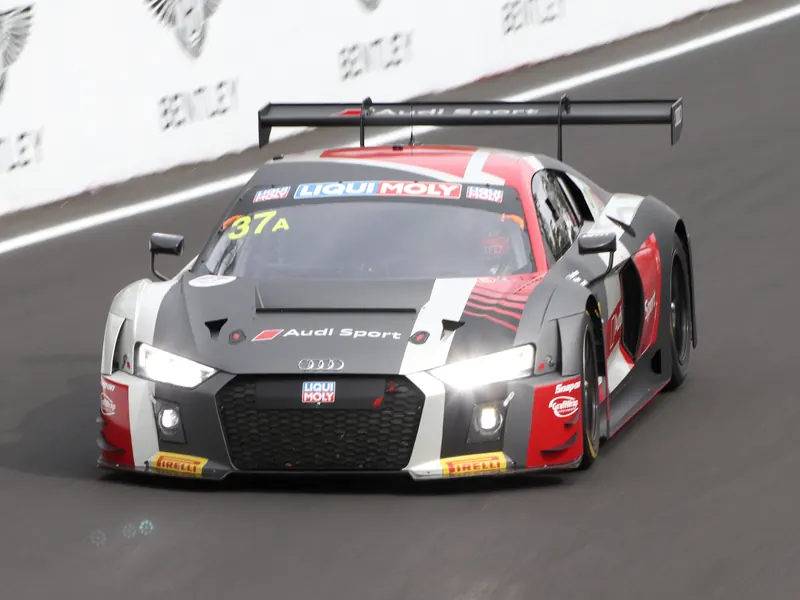
On the track, Audi R8 LMS cars won the Bathurst 12 Hour in 2011, 2012 and 2018. In March 2026 Audi made its Formula 1 debut at the Australian Grand Prix in Melbourne, where Gabriel Bortoleto scored the team's first points.

A grey, white and red Audi R8 LMS race car with a large rear wing, driving at Mount Panorama
The race-winning Audi R8 LMS of the 2018 Bathurst 12 HourKytabu · CC BY-SA 4.0

Myth or fact?

Three things people get wrong

Open a card for the fact.

MythAudi was founded in 1932, when the four rings appeared.Tap for the fact
Fact

There is no single founding date. August Horch started the company that became Audi in Zwickau in 1909, and the first car with the Audi name was delivered in May 1910. The four rings date from 1932, when Audi, DKW, Horch and Wanderer's car division joined as Auto Union AG, and the company has been called AUDI AG only since 1985.

MythThe quattro was the first four-wheel-drive car.Tap for the fact
Fact

Audi's own wording is more careful: the first high-volume car with permanent all-wheel drive. Earlier all-wheel-drive road cars existed, and the Jensen FF of 1966 is described as the first.

MythThe Silver Arrows were Mercedes-Benz race cars.Tap for the fact
Fact

Both German teams earned the nickname. Auto Union's V16 cars, with the engine behind the driver, wore a striking silver finish from their first race at Berlin's Avus on 27 May 1934, and Audi still calls its historic racers the Silver Arrow family.

By the numbers

Audi in four figures

4
brands in the four rings: Audi, DKW, Horch and Wanderer
406 km/h
Bernd Rosemeyer in an Auto Union, October 1937
13
Le Mans wins, from 2000 to 2014
397 laps
at Le Mans in 2010, a distance record of 5,410.7 km