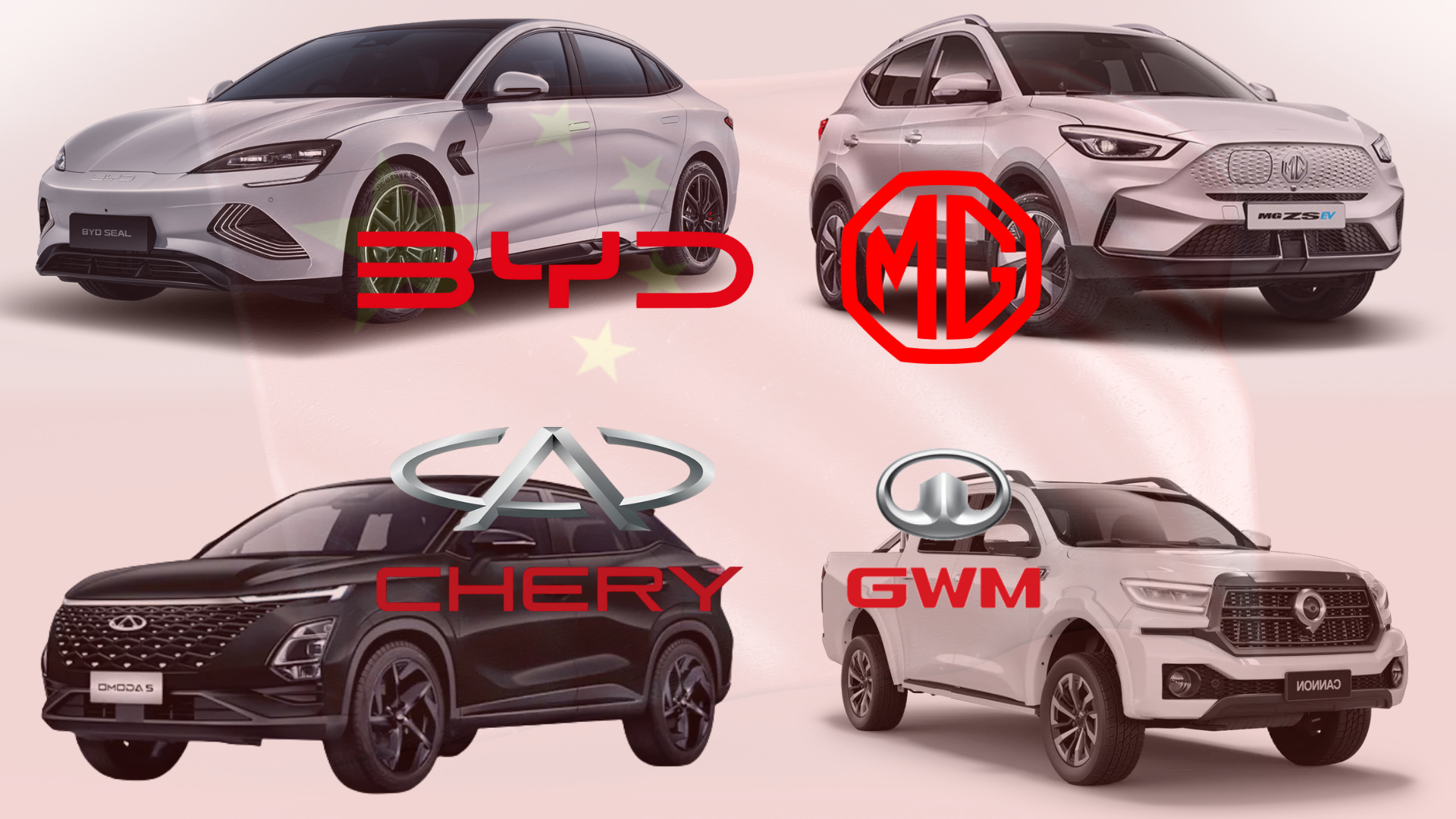
Australia’s new-car market is undergoing a rapid makeover. Chinese automakers have surged to claim a large share of sales, driven by budget-friendly pricing, modern design and an expanding line-up of electric (EV), hybrid and petrol models. In August 2025, four Chinese brands – BYD, Great Wall Motors (GWM), MG and Chery – all broke into the national top 10 selling brands for the first time.
BYD alone leapfrogged Mitsubishi to become the 6th biggest brand that month, nearly quadrupling year-on-year sales. Chinese-built vehicles accounted for roughly 17.5% of Australia’s new-car sales by mid-2025 (up from just 2.7% in 2020). That dramatic rise made China the second largest source of cars sold in Australia (after Japan) for the month, with over 141,800 Chinese-made vehicles delivered year-to-date (Jan–Aug 2025).
- Top 10 breakthrough: All four Chinese brands mentioned above placed in August 2025’s top-ten – BYD (6th), GWM (8th), MG (9th) and Chery (10th). This ousted long-time players like Isuzu Ute and dented sales for Volkswagen and Nissan.
- Sales surge: Year-to-date (Aug 2025), Chinese manufacturers sold about 161,500 cars in Australia (plus an additional ~23,000 if counting China-made Teslas/Polestars). That is up 27% on the prior year. Individually, BYD deliveries hit ~32,800 units (up 146% YoY) and GWM ~34,400 (+23%). Chery’s volume jumped a remarkable +230% to over 20,500 sales. (By contrast, Japanese brands Toyota and Mazda both saw sales declines in 2025, reflecting the competitive pressure from China.)
This growth isn’t a fluke. The Federal Chamber of Automotive Industries (FCAI) notes the market is “more diverse as Chinese carmakers increasingly offer competitive prices and a greater range of electric vehicles”. FCAI boss Tony Weber emphasizes that Chinese models today deliver “modern, well-equipped” vehicles at low prices. In practice, models like the BYD Dolphin EV (a small hatch) start around A$30,000 – undercutting many established EVs.
Even more are on the way: for example, GAC’s upcoming Aion UT EV is predicted to steal the crown as Australia’s cheapest electric car by undercutting the Dolphin by several thousand dollars. This intense price competition has caught buyers’ attention.
At the same time, Chinese firms are not selling “cheap and nasty” budget cans. They’ve spent heavily on engineering, often leveraging partnerships with foreign companies. Geely (owner of Volvo and Lotus) has imported Swedish engineering know-how; GWM and others have hired ex-Holden and German engineers. The payoff is visible in safety and quality. Recent industry studies show Chinese cars have dramatically closed the gap in reliability and build quality.
A 2024 J.D. Power report found Chinese brands like Chery, Geely and GAC scoring near global averages for dependability. In fact, Chinese car reliability is improving faster than any other country’s – shrinking problems per vehicle each year. Brands such as Haval (GWM’s SUV arm) now rank highly in reliability surveys. Chery even offers a one-million-kilometre engine warranty in some markets, underscoring confidence in longevity.
Safety is another area where Chinese cars impress. In 2025, several Chinese models earned five-star ANCAP crash ratings, the highest score in Australia’s safety tests. For example, the all-electric BYD Sealion 7 SUV achieved five stars, with excellent occupant protection and full scores on side-impact tests. Geely’s EX5 EV similarly earned five stars. ANCAP noted that these cars included advanced child-presence alerts and strong automated braking systems.
As one Aussie reviewer put it, these results give families “real peace of mind” for an electric ride that doesn’t skimp on protection. In short, the newest Chinese vehicles often meet or exceed the safety hardware of mid-range European or Japanese models.
At the same time, it’s fair to compare how Chinese marques stack up against their German and Japanese counterparts. European brands (VW, BMW, Mercedes) still lead in high-end refinement and driving dynamics, and Japanese brands remain benchmarks for rock-solid reliability. Skoda – a Czech company in the VW group – recently warned consumers to be wary of very cheap Chinese EVs: Skoda Australia explained that its new Elroq SUV benefits from decades of R&D, whereas some Chinese entrants may have cut development corners to hit low price points.
As Skoda’s marketing chief bluntly put it: “You get what you pay for“. In other words, the ultra-low sticker price of a Chinese EV might reflect lower investment in long-term durability. And indeed, some industry experts concede that although Chinese EVs pack in tech and value, they haven’t historically driven as sharply: “Chinese vehicles are still decades away from being world-standard” in dynamics, one electric-car boss noted.
That said, Chinese companies are actively upgrading their craftsmanship. Great Wall (maker of Haval and the GWM Cannon ute) even rehired former Holden engineers and opened R&D facilities in Victoria, tuning ride and handling for local roads. MG (owned by China’s SAIC) has likewise improved fit-and-finish across its SUVs and EV hatchbacks. As more of these cars hit the road, customer feedback and competition will keep driving quality upward.
One major arena where Chinese brands shine is electrification. Australia’s overall EV market is still small (about 10–15% of sales), but Chinese companies lead its growth. In mid-2025, EVs hit a record 10.3% market share, fueled largely by Chinese models. BYD and Geely were responsible for four of the top seven selling EVs in June 2025.
Sealion 7 mid-size SUV and smaller Seal sedan frequently ranked #2–#5 in monthly EV sales, while the budget BYD Dolphin and Atto 3 placed in the top 10. Even Geely’s first Aussie EV (the EX5) jumped into the high ranks thanks to a cash-back promotion. MG, too, is competing: its MG4 EV Hatch and flagship MGS5 sedan together accounted for hundreds of monthly sales as of mid-2025. The net effect is clear: Chinese EVs are rapidly carving out space alongside Tesla and European EVs on Australian roads.
Traditional petrol and hybrid models also feature. Great Wall and LDV (SAIC’s truck arm) sell utes and vans locally – for example, the GWM Haval Jolion is a best-selling Chinese SUV, and the LDV T60 ute pulls tools for many tradies. BYD’s new Denza brand (spun off for luxury PHEVs) has launched a Shanghai-model SUV in Australia.
The takeaway: Chinese players are attacking every segment from city hatchbacks up to off-road utes. In particular, their upfront pricing often undercuts comparable Japanese or Korean models – tempting buyers who might otherwise have bought a Toyota or Mazda.
From the consumer’s perspective, that value proposition is everything. As an Australian auto journalist observes, many drivers prioritize “value, design and technology” over high-speed thrills. Chinese cars excel here: they tend to be “bright, new and shiny,” bristling with touchscreen infotainment, safety gadgets and luxury-style features that were once rare at the budget end. In one reviewer’s words,
Chinese models cram “cutting-edge cabin tech” into every trim, making even basic buyers feel pampered. It’s no wonder these cars feel like a special treat to shoppers who previously had only stripped-down econoboxes to choose from.
This combo of tech and low price also translates into cheap used-car deals. Listings on platforms like Carsales often show Chinese models (MG ZS, BYD Dolphin, LDV D90 etc.) at lower used prices than their Japanese equivalents of the same age. For buyers in Melbourne and elsewhere hunting “used cars” on a budget, the faint stigma of the “old cheap Chinese” stereotype is fading in favour of real value.
Reports indicate Chinese vehicles hold value better than early adopters feared, thanks to improved quality and long warranties. In short, even on Carsales’ classifieds, Chinese models are rapidly moving from classifieds afterthoughts to mainstream entries under the cheap used car category.
All of the above illustrates a bigger market shift. The rise of Chinese brands hasn’t just boosted their own numbers – it’s put pressure on global incumbents. Toyota remains Australia’s #1 seller (mainly with hybrids like the RAV4 and Corolla), but even it saw sales dip slightly in 2025. VW Group, Nissan and Mazda each saw their sales slide year-on-year as Chinese competition heated up.
Ute specialist Isuzu even dropped out of the top 10 brands. Even Tesla, a Chinese-owned firm by some counts, saw its Model 3 slump in 2025 amidst increased competition and local controversies. In other words, Chinese brands are reshuffling the auto hierarchy. The FCAI and experts note that Chinese vehicles’ popularity reflects consumers finally having compelling alternatives in every price bracket, not just legacy cars.
Looking beyond Australia, this trend is part of China’s global auto push. Trade tensions and tariffs have limited Chinese brands’ entry into Europe and the U.S. for now, so Australia – with its open market and mature auto culture – is a prime proving ground.
Chinese firms are taking note: they pack up at Aussie car shows, test cars here extensively (even tuning them at Holden’s old proving ground), and build dealer networks ready for growth. Local analysts expect that if the Chinese continue this trajectory, they could claim close to 40% of Australia’s sales by the mid-2030s (according to industry estimates).
In summary, Australian motorists are giving Chinese car brands a warm reception. By 2025 these companies have delivered on their promises: offering modern, well-equipped, competitively-priced vehicles. They have bridged the old quality gap – racking up five-star safety ratings and improving reliability metrics – while simultaneously flooding the market with high-tech EVs and affordable SUVs.
The result is positive competition for consumers: more choice, more innovation, and lower prices. Whether buyers want a cheap new EV, a feature-rich small SUV or a budget used car, they now often find a Chinese option near the top of their list. As one industry observer put it, this isn’t a passing fad: Chinese automakers have “arrived” in Australia, and their impact on the 2025 market is unmistakable.