Imagine sitting in your car, tapping your phone or enjoying a coffee while your vehicle drives you safely to your destination — no hands on the wheel, no eyes on the road, no stress. It’s the bright promise that future mobility holds, and it feels like something straight out of a sci-fi movie turned reality. But if you’re wondering whether Australia — and the world — is truly ready for fully autonomous cars, the answer isn’t a simple “yes” just yet. We’re making progress, but the timeline remains measured, cautious and dependent on technology, regulation and infrastructure.
In this research-focused article, we’ll walk through what’s happening now, what’s coming soon, and when we might realistically expect fully autonomous vehicles to become part of everyday life — all written clearly for Australian and global readers alike.
What “Fully Autonomous” Really Means
Autonomous driving systems are categorised into levels from 0 to 5, according to international standards:
-
- Level 0–2: Driver still fully responsible, with systems like cruise control and lane assist.
-
- Level 3: Cars can handle certain driving tasks but still require driver attention.
-
- Level 4: Cars can operate without human input in defined scenarios.
-
- Level 5: Full autonomy — no driver required at all.
- Level 5: Full autonomy — no driver required at all.
Today’s commercially available vehicles are mostly Level 2, with features such as adaptive cruise control and lane keeping, which help drivers but don’t replace them. These systems tease the promise of autonomy, but they’re far from letting you nap in the back seat. (RACQ)
Where Australia Stands Now
In late 2025 and early 2026, we’ve seen important developments in Australia:
-
- Tesla’s Full Self-Driving (Supervised) system has officially launched locally. It allows hands-free steering, acceleration and braking, but drivers must remain alert and ready to take control at any moment. (Sohu)
-
- Large-scale demonstrations of this technology — such as 600+ test drives in Melbourne — have helped educate the public and accelerate commercial conversations. (Blockchain News)
-
- Meanwhile, regulatory frameworks are starting to be developed through national strategies. These recognise autonomous technology but still lack detailed governance protocols, especially on who is accountable when the automation hands control back to a human. (UNSW Sites)
Australia’s current laws still require a human driver to be in control at all times on public roads. No state has yet fully authorised Level 3 or above in general traffic conditions. (RACQ)
Global Timelines & How They Compare
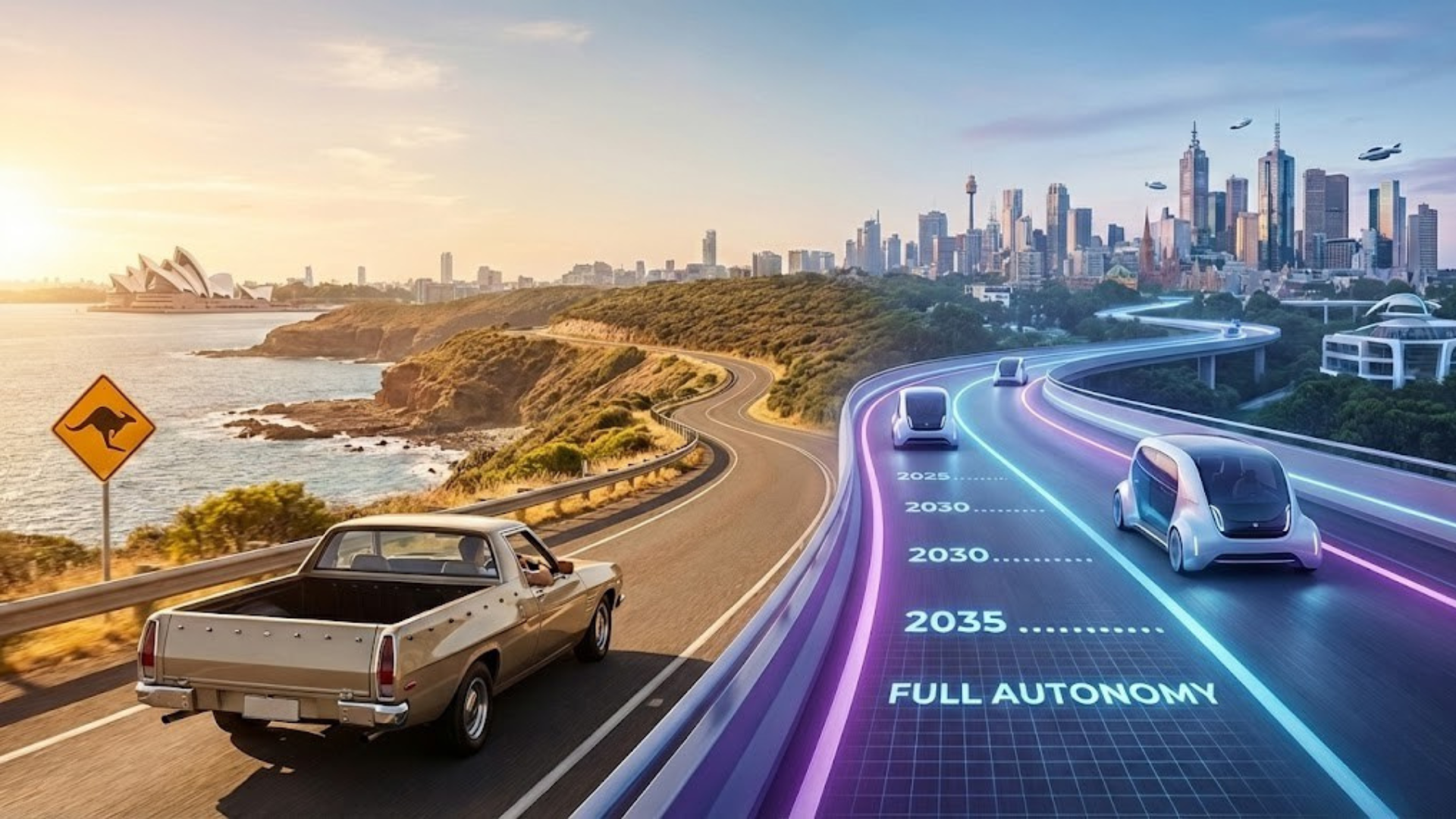
Worldwide, the race for autonomy is progressing, but there’s no single moment on the calendar when “full autonomy” suddenly happens.
Short-term (2024–2026):
-
- More sophisticated driver assistance systems become standard in new vehicles globally.
-
- In Australia, regulators continue to develop frameworks while companies conduct trials and demos. Trials by overseas companies like Waymo (which already operates autonomous taxis in the US) are exploring entry into Australian cities, signalling interest in future testing and trials here. (Reddit)
Medium-term (2026–2030):
-
- Many forecasts suggest broader commercial deployment of Level 3 systems and controlled deployments of Level 4 in limited environments.
-
- Some authorities expect a small percentage of new cars to be “highly or fully automated” by 2030, though this varies by region and type of driving. (Forbes Australia)
Long-term (2030–2035+):
-
- Widespread adoption of true Level 4/5 vehicles — ones that can operate without human supervision in most conditions — is more likely in the mid-2030s or later, according to industry analysis. (News.com.au)
- Widespread adoption of true Level 4/5 vehicles — ones that can operate without human supervision in most conditions — is more likely in the mid-2030s or later, according to industry analysis. (News.com.au)
Why It’s Taking Time
Autonomous cars aren’t just about clever AI and sensors. They depend on:
-
- Robust regulation — Governments must ensure safety and legal frameworks are in place.
-
- Infrastructure upgrades — Roads, signage and data connectivity all play roles.
-
- Public trust and safety validation — Incidents involving trial systems overseas have shown that overreliance without full readiness has risks. (News.com.au)
- Public trust and safety validation — Incidents involving trial systems overseas have shown that overreliance without full readiness has risks. (News.com.au)
In short, technology may be capable in certain controlled environments before the laws and our cities are ready to support truly driverless cars everywhere.
The Safety Opportunity
Despite the long timeline, the promise of autonomous mobility is significant: reduced human error, improved efficiency and safer roads. Many advocates point out that most crashes are caused by human mistakes, and autonomous systems, if perfected and regulated properly, could drastically reduce these. (china2au.com)
However, early systems still require careful development and supervision to ensure they improve safety without introducing new risks.
What This Means for Everyday Drivers
Even as fully autonomous cars inch closer, most Australians will still experience gradual enhancements:
-
- Enhanced driver assistance in used car markets — more vehicles with progressive safety tech available on sites like carsales.
-
- Semi-autonomous features in new and cheap used cars will become more common in the next few years.
-
- Cities such as Melbourne may eventually participate in controlled trials and infrastructure adaptation.
- Cities such as Melbourne may eventually participate in controlled trials and infrastructure adaptation.
In other words, autonomy won’t be a sudden shift, but rather a positive evolution of the driving experience, one step at a time.